

1. Google Launches Discover Update
On February 5th, Google announced the rollout of the February 2026 Discover Core Update. This update focuses specifically on the systems that surface articles in Discover with the goal of improving the quality and locality of those articles and reducing clickbait and sensational content. Users will still see content based on their personalized preferences; otherwise, Google will show sources that have proven topical authority.
While Discover typically focuses on news and current events, we have had ecommerce clients appear in the feed because their expertise was proven and trusted. Helpful, original Informational content focused on topics relevant to your products and services can help you show up in Discover.
2. Yahoo Introduces Scout, a New Player in AI Search & Discovery
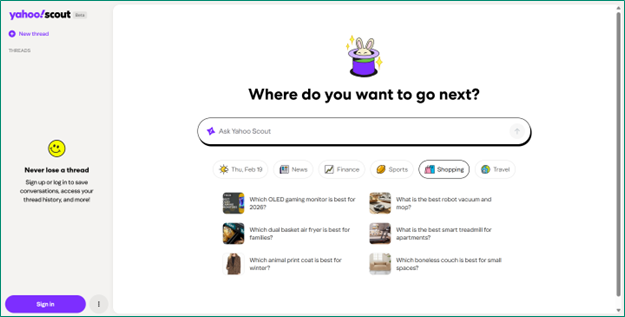
Yahoo is making a bold return to the search landscape with Yahoo Scout, an AI-powered search engine and companion. Scout leverages Anthropic’s Claude as its foundational AI model, Microsoft-powered Yahoo Search, and information from Yahoo’s rich ecosystem of mail, news, finance, sports, weather, shopping, and search to create a comprehensive discovery platform.
Something that sets Yahoo Scout’s interface apart from other AI engines is its playful, intuitive design. The content curation strikes a balance between algorithmic efficiency and editorial experience.
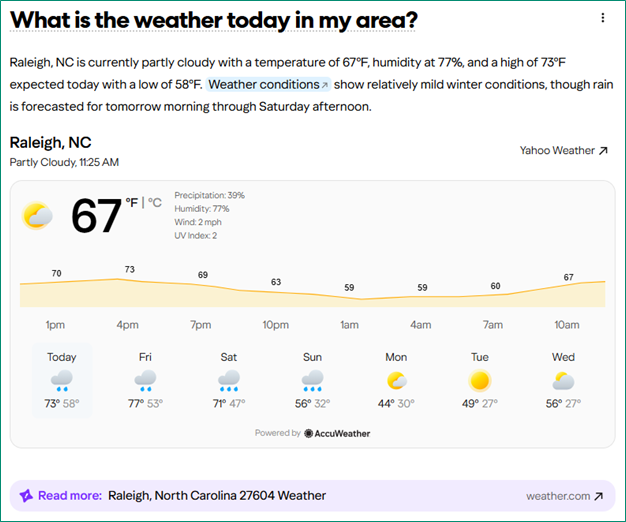
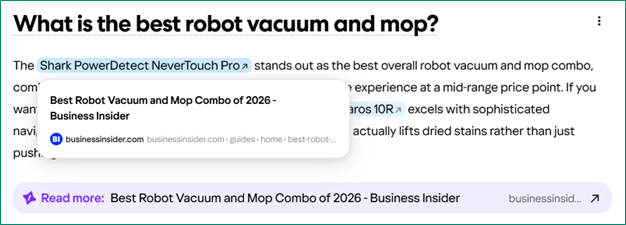
Yahoo Scout presents opportunities for publishers and ecommerce retailers. The platform is designed to drive traffic back to original sources through robust citation systems, including both in-text citations (highlighted in blue) and one Featured Source (highlighted in purple) per output. Yahoo representatives noted that they’re still not sure what to expect in terms of click-through rates.
Monetization occurs through multiple channels: Microsoft’s ad platform powers some search results using a cost-per-click model rather than an impression-based pricing model, while commerce-related queries are monetized through affiliate commission structures. This dual approach suggests that Yahoo Scout could become a significant new channel for both organic discovery and paid advertising.
3. Near-Future Siri Updates Will Be Powered by Gemini
In January, Apple and Google struck a deal for Siri to be powered by Gemini, and this month, news has leaked that the iOS 26.4 update, to be released within the next few months, will result from that deal.
The 26.4 iOS update for iPhone, iPad, and Mac will retain the current interface, add the ability to analyze on-screen data, and reportedly improve web search. IOS 27 is expected to be released in 2027 and will introduce a new interface, still called Siri, that promises to be much more advanced than the current iteration.
4. Google Introduces Substantial Personalization to Gemini
In mid-January, Google started rolling out Personal Intelligence to Google AI Pro and AI Ultra subscribers in the U.S., with the promise that it would eventually be available to more users in the future.
Personal Intelligence allows users to connect their Gmail, Photos, YouTube, and Search to Gemini for a deeply personalized experience. Users will be able to opt in, opt back out, and provide feedback about the experience.
Google explained that Gemini should cite where in the product ecosystem it found the answer to your questions, and that you’ll be able to ask for more information. You can also ask for a different, less personalized answer if it seems “off” to you. This feels like we’re getting closer to having access to an AI assistant like Jarvis from Marvel’s Iron Man comics, but we’ll see what the feedback says as Personal Intelligence rolled out more fully.
5. Search Policies Don’t Change with AI Advancements
In an exchange on Bluesky, Lily Ray asked whether Google will continue developing updates around Search and the manipulation of search engines (spam). Googler John Mueller’s answer is a great reminder for all of us that advancements in AI do not change the fundamentals of SEO:
“I don’t think these things fundamentally change. Search has a looong history, with lots of experience & expertise. Of course there’s *some* change – none of these things live in isolation, search evolves outside of AI, and the web is a dynamic place.”
6. Study Shows Clicks Shifting from Organic to Paid Ads
In the era of zero-click results, thanks to AI, we’ve seen organic clicks decline across industries, but there’s something else happening at the same time. In a recent study, Aleyda Solis showed that some of the clicks that still occur are shifting from organic links and free shopping placements to paid text ads and product listing ads.
While the total click volume is decreasing across top queries, thanks to an exponential increase in AI Overviews, user behavior is changing. So, what are we to do?
- Continue implementing good SEO practices. The SERPs change from day to day, but as John Mueller said above, Search is not going away, and good SEO is the foundation for good GEO (generative engine optimization).
- Optimize pages for GEO to have a better chance of being sources in an AI Overview, AI Mode, or the LLMs, like ChatGPT and Gemini. While clicks may not come directly from being sourced, brand recognition, authority, and trustworthiness are enhanced when Google shows your page is worthy of citation.
Ensure your Paid Media, Feeds, and SEO teams are collaborating for holistic coverage on the SERPs. The less siloed your teams are, the bigger your presence on Google’s pages can be. One of the many benefits of having these services with a single agency is that collaboration amongst teams is easier.
ICYMI: Recent SEO Blog Posts
How to Optimize for AI Search Engines: The 2026 Guide to Generative Engine Optimization (GEO)