

Marketers need good data to make good decisions, but with advertising and measurement platforms adapting to privacy regulation, attribution data is becoming decreasingly reliable. Smart marketing teams are looking for ways to understand which channels or tactics are actually driving incremental growth.
Recent research from eMarketer shows that incrementality testing is rapidly gaining adoption as marketers seek more causal approaches to performance measurement. Incrementality testing is designed to answer that simple, but critical question: what would have happened if we had not run this marketing at all?
For brands deploying six- and seven-figure monthly media budgets across multiple channels, this question matters more than ever.
What Is Incrementality Testing in Marketing?
Incrementality testing is a measurement approach that isolates cause and effect by comparing outcomes between two groups of consumers. One group (called the Variant or Treatment) is exposed to a marketing channel or campaign, and the other (the Control) is not.
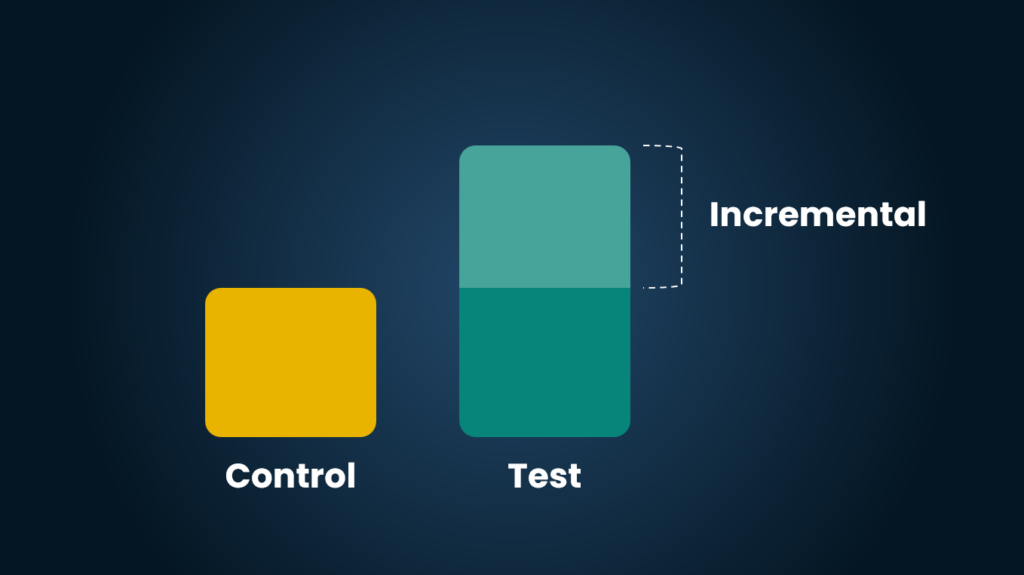
If the Variant drives more revenue than the Treatment, the difference in performance between those groups represents incremental impact. In other words, incremental impact is the growth that would not have occurred without the advertising that was applied.
Unlike traditional attribution, incrementality testing does not rely on click paths, cookies, or platform-reported conversions. It is focused on causality, not correlation. That makes it especially valuable in a privacy-first world where user-level data is increasingly incomplete.
Incrementality testing can be applied in many ways, including channel-level tests, geo-based tests, audience holdout tests, and platform-specific experiments. The structure matters, but the goal is always the same: measure true business revenue lift, not just reported conversions.
A good incrementality test, like any scientific experiment, starts with rigorous test design: controlling for as many variables as possible so that the variable you’re trying to measure (like channel spend) is the only one influencing the response (revenue).
Why Attribution Alone is No Longer Enough
Attribution still plays an important role in modern measurement, but it has clear limitations.
Most attribution models assign credit based on observed interactions. As tracking consumer interactions across devices and channels becomes more difficult, those signals have become harder to capture consistently. Multiple platforms may take credit for the same conversion, while other conversions are entirely unattributed.
Incrementality testing helps fill that gap by validating whether attributed performance reflects true incremental value. It provides a way to pressure-test attribution claims rather than taking them at face value.
Incrementality testing should not replace attribution but rather sit on top of it as a validation layer.
How High-Growth Brands Apply Incrementality Testing
Brands that use incrementality testing effectively apply it to high-impact decisions rather than using it as lower-level optimization lever.
Common use cases include:
- Validating whether a channel is driving incremental revenue or simply capturing existing demand
- Testing the “true” value of upper-funnel or awareness-focused campaigns
- Evaluating the impact of budget increases or decreases
- Understanding diminishing returns at higher spend levels
A sophisticated marketing team uses incrementality tests to create a bigger-picture roadmap, while attribution data drives day-to-day adjustments.
When Incrementality Testing Works Best
Incrementality testing is more effective when a few conditions are met:
Sufficient scale: Tests require enough volume to reach statistical significance. Small budgets or low conversion volume can lead to inconclusive results. While the exact number of users varies depending on your baseline metric and the effect size (the difference in performance between the two groups), typically thousands to tens of thousands of users are in each group.
Reliable measurement foundations: While incrementality testing does not rely solely on attribution, clean event tracking and consistent conversion definitions are critical for interpreting results.
Clear, strategic hypotheses: Incrementality testing works best when teams know exactly what question they are trying to answer before launching each test. Without that clarity, results can be misread or misapplied.
Organizational buy-in: Incrementality testing often challenges long-held assumptions. Teams need to be prepared to act on results, even when they point to uncomfortable changes to tactics or budgets.
Incrementality testing can be a powerful input for making more informed marketing decisions, but it is not a silver bullet. Like any advanced measurement approach, incrementality testing amplifies both strengths and weaknesses in your measurement setup.
Additionally, designing a “test” that doesn’t meet scientific rigor of a true incrementality test is a risk. Making decisions based on bad test data can derail your momentum and turn performance in a negative direction.
When used intentionally and interpreted correctly, incrementality testing provides clarity that attribution alone cannot.
Want to See How Incrementality Testing Fits into a Modern Measurement Framework?
As signal loss increases, attribution gaps will continue to widen. Without incrementality testing, brands risk scaling channels that are harvesting existing demand rather than creating new growth, underfunding channels that are fueling that growth, or both.
Incrementality testing is one component of a good modern measurement strategy. Our Modern Measurement Playbook outlines how high-growth brands structure incrementality testing, attribution, first-party data, and marketing mix modeling to guide multi-million-dollar allocation decisions.
Download the Modern Measurement Playbook to see the full framework and understand when and how to apply incrementality testing effectively.
Need Expert Support?
The business intelligence and data science team at ROI Revolution works with brands to design incrementality tests, interpret results, and connect insights back to real budget decisions. Book a call to see how we can help you build a stronger measurement foundation and use incrementality testing to fuel growth.