


AI search has gone from a novelty to a mainstream shopping and research tool in just twelve months. We’re breaking down how the data has shifted, what it means for your organic traffic, and the concrete steps you can take now to show up, and be trusted, in AI search before the holiday season ramps up.
A year ago, most people didn’t trust AI chatbots enough to shop with them. Today, half of US adults use AI regularly, and a growing share of them are using it to research gifts, compare brands, and build shopping lists before the holidays even start. If your GEO strategy hasn’t caught up to that shift, now is the time.
We pulled together the data from the past year to show exactly how fast this has moved, what it’s doing to your organic traffic, and what you can do about it heading into Q4.
AI Search Trends & User Behavior
Around this time last year, AI tools simply weren’t reliable enough to earn much consumer trust. Hallucination rates hovered around 50%, and only about 5% of chatbot responses included a clickable source URL. When AI tools didn’t know an answer, they’d often make one up – including fabricating URLs that led nowhere.
That’s changed a lot in twelve months, and two updates in particular reduced friction and improved user trust.
- September 29th 2025: ChatGPT rolled out instant checkout, making it dramatically easier to complete a purchase without leaving the chat. Traffic and revenue from AI tools jumped almost immediately after.
- May 7th 2026: A ChatGPT updated increased the number of branded URL links within responses, from roughly 5% up to 24%. Each link is a clickable attributed referral; this change caused ChatGPT referral traffic to nearly double practically overnight. We saw ChatGPT traffic increase 50%-158% in May (month-over-month) and stay there.
Google has also woven AI directly into search and its own ecosystem. AI search is now built into new phones and smartwatches, not just the search bar.
AI Adoption In the US:
In the US, consumers are getting more comfortable using AI regularly. Americans are using chatbots more than ever before, and some are bringing smart devices into their households, according to a new Pew Research Center survey of U.S. adults.
The Key Takeaways:
- 50% of US adults now say they use AI regularly, up from about 30% 1 year ago.
- 40% of US adults use AI specifically for research.
- Adoption by age: 18–34 year-olds are the heaviest users (about 53% of the total user base), followed by 35–54 year-olds (about 30% of that group), while only 15% of adults over 55 report regular use.
- Adoption by gender: Usage is fairly even between men and women.
In terms of market share, ChatGPT still dominates at roughly 78% globally, followed by Gemini (10%), Perplexity (7%), and Claude (3%), with the remainder split across other tools. Claude’s share has grown meaningfully in the past few months, largely driven by workflow automation use cases rather than shopping.
How Shoppers Are Actually Using ChatGPT
What users are doing inside of ChatGPT will have a big impact on holiday shopping behavior. Last year cosumers tested using LLMs, this year it is used heavily for product research:
- 63% of online shoppers use ChatGPT to compare brands.
- 46% use it for gift inspiration.
Shoppers are also using it to discover new products, compare prices, hunt for promos, summarize reviews, and build shopping lists.
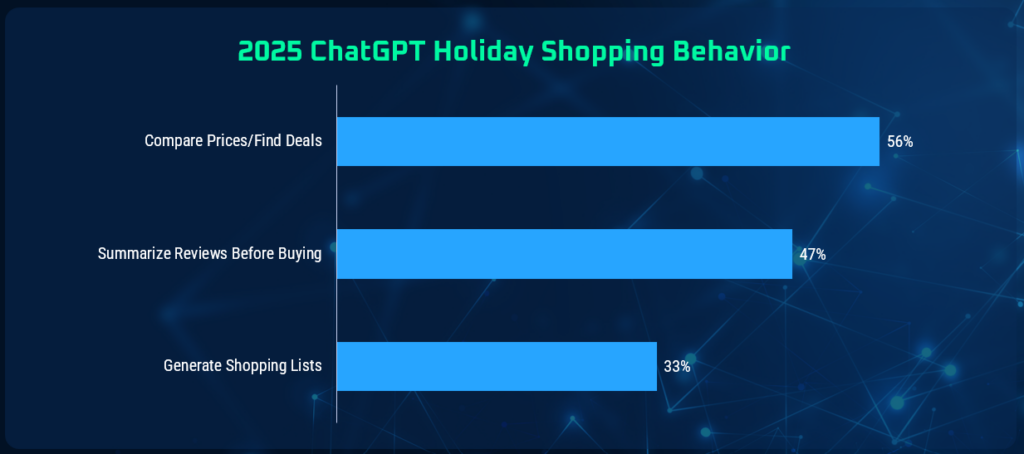
Source: DIGIDAY
But trust is still conditional, and shoppers are still very skeptical of AI responses. According to Yext Consumer Search Behaviors Report 2026:
- 62% of users immediately check Google to verify the AI response is correct.
- 58% of users visit the brand’s website directly.
- 52% click through to sources the AI cited
Trust in AI answers is increasing, but shoppers verify AI answers using the brand’s website. Your website’s messaging needs to be clear, and answers need to be easy for users to find.
The Product Research Phase
For online shopping, the research and comparison phase of holiday shopping is moving upstream into AI conversations. It is more important than ever to ensure your website is ready for these conversational prompts. To prepare your site for AI search, you should check these key areas:
- Product details: Consumers are using very specific long-tail queries to find exactly what they need. Make sure your product descriptions include key product specs and details to ensure they are cited for specific use cases. You must make it clear what the product is, who it is for, and why it helps your target audience.
- Website Content: The content on your website needs to be easy to find for both users and AI bots. You need to make sure your brand information is clear, consistent, and helpful.
- Brand Reputation: LLMs rely on reviews from Google, Trustpilot, and your website to form opinions about your brand. If negative reviews are not addressed, they can become AI facts.
According to Stackline, shopping-related ChatGPT queries jumped from 15 million per week in January 2025 to 84 million per week heading into last Q4, and we expect that number to climb again this year.
How AI Search is Impacting Organic Search
AI adoption isn’t just changing how people shop with chatbots – it’s reshaping the organic search results page itself.
- A study found AI Overview appearances are up 10–30% year-over-year.
- The same study found organic click share is down 11–23% year-over-year, partly because AI Overviews and larger sponsored placements are pushing traditional listings further down the page. Where a page one search result might once have shown eight organic listings, some queries now show six or fewer.
- LLM referral traffic is growing, but it’s still small relative to total organic. For ROI Revolution SEO clients, LLM referral traffic is typically somewhere between 0.5% and 4.9% of a site’s organic traffic, or roughly 1/20th to 1/200th the size.
- LLM traffic also converts at a lower rate than traditional organic traffic right now (0.8% vs. 1.5% for our SEO clients), since most people are still in the research phase when they click through from an AI tool. Organic search remains the primary destination once someone is ready to buy.
The good news: being cited in an AI response is a trust signal that can help your traditional rankings too, and it tends to drive branded and direct traffic later in the purchase journey, as people first discover your brand through AI and then go looking for you through traditional search. The click-through data makes the stakes clear:
- No AI Overview present: about 3.4% CTR
- AI Overview present and your brand is cited: about 2.1% CTR
- AI Overview present and your brand is not cited: less than 0.9% CTR
You can’t control whether Google shows an AI Overview for a given query. You can control whether you’re visible inside it.
How to Improve Your AI Visibility
A few foundational moves will help both your traditional SEO and your AI visibility:
- Structure your content clearly. Use a real header hierarchy (one H1, a handful of H2s, H3s where needed) so both humans and bots can quickly understand a page’s purpose.
- Write for skimming. AI tools, like people, don’t want to dig through dense paragraphs for the answer. Lead with the important information.
- Reinforce E-E-A-T. Make sure informational content has a credible, named author with the expertise to back up what’s written.
- Get specific about who you are. A simple framework that helps: “[Your brand] is a leading [description of what you do and who it’s for].” This kind of clear positioning — called a semantic triple — gives AI tools an easy, consistent way to describe you.
- Format product and blog pages for scanning: a clear summary near the top, shorter paragraphs, and real bullet points instead of walls of text.
Common Issues That Can Hurt Your AI Visibility
1. Negative reviews
AI tools pull heavily from Google, Trustpilot, and even Reddit to form an opinion about your brand. If old negative reviews aren’t addressed, those reviews can become AI facts. LLMs have a tendency to amplify negativity and highlight common issues. A single outdated piece of feedback could define your brand within an LLM.
It is very important to stay on top of your review strategy to protect your brand reputation in AI search. A 2026 review strategy should include:
- Checking LLMs to see which review sources are used most often for your brand
- Encouraging recent authentic reviews on these platforms to make sure your grand is represented accurately.
- Addressing negative reviews and ensuring customers are getting the assistance they need.
At ROI Revolution, we assisted a brand with improving their sentiment within LLMs by addressing old negative reviews. We analyzed the reviews for common issues and created custom scripts for their customer service team to use for each issue type. We also worked with their team to optimize review request timing. This resulted in their Google rating increasing from 3.4 stars to 4 stars and a 47% improvement in LLM visibility. If you need help with your brand’s AI search reputation, reach out to our reputation management team today.
2. Inconsistent Brand Messaging
AI tools don’t like to say “I don’t know.” If your positioning isn’t clear and consistent across your site and other channels, an AI tool will fill in the gaps with its own assumptions – and it might not get your story right. You need to be very clear on why AI search tools should recommend you over a competitor.
Brand positioning is now more important than ever before. LLMs need to know when to send customers your way, and you need to make that information easy to find. The key lies in being incredibly clear about what you want your brand, product, or service to be known for. Defining your market position is the essential first step in building brand authority in AI search.
3. Incomplete Product Data
Shoppers are asking increasingly specific, conversational questions: exact dimensions, materials, compatible accessories, etc. If that information isn’t easy to find on your product pages, AI tools are likely to recommend a competitor who has it.
Two things help here: making key specs easy to find (not buried three clicks deep within an image) and optimizing product schema markup so bots can pull accurate details quickly.
Tracking LLM & AI Overview Growth
A few practical ways to start tracking your AI visibility:
- Build an LLM referral report. Pull sessions, revenue, and conversion rate by AI platform (ChatGPT, Perplexity, Claude, etc.) so you can track trends over time, not just anecdotally.
- Track by topic, not just keyword. Traditional keyword search volume data doesn’t really exist yet for AI platforms, and queries tend to be longer and more conversational. Tracking visibility across topic clusters relevant to your business gives a better read on whether AI tools consider you a trustworthy source in your category.
- Use the new AI visibility features in Google Search Console. Google has begun rolling out an AI visibility dashboard for AI Overview and AI Mode impressions. Check under “Search results” in the left-hand menu to see if it’s available for your account yet.
- Treat AI Overview optimization as part of your organic strategy. Since direct AI Overview clicks aren’t fully trackable yet, the best proxy for success is improvement in your relevant organic keyword rankings and overall organic traffic and revenue for the pages you’re optimizing.
The Bottom Line
AI search adoption has moved faster in the past year than almost anyone expected, and holiday shoppers are already using it to research, compare, and shop. The brands that show up – and show up accurately – in AI tools this season will be the ones with clean, complete, well-structured data and a consistent, well-managed online reputation. The good news is that most of the work involved is an extension of good SEO fundamentals you’re likely already doing. It just needs a GEO lens on top of it.
Need Expert Support?
Our SEO and GEO team helps brands prepare for exactly this kind of shift – from reputation management to product data optimization to AI visibility tracking. Contact us today to get your site ready for the holiday shopping season.
Sources
- Profound, ChatGPT Intent Study: What 50M+ ChatGPT prompts reveal
- Precise, How ChatGPT Shops
- ROI Revolution, How to Improve Brand Visibility in AI Search Engines
- New York Times, AI Hallucination Rates
- Profound, ChatGPT Referrals: Branded Links
- Pew Research Center, Americans and AI 2026: Chatbots, Smart Devices and Views on Impact
- Yext Consumer Search Behaviors Report 2026, The AI search tipping point has already happened
- Stackline, ChatGPT is becoming a shopping destination
- Aleyda Solis, Search Isn’t Just Turning to AI, it’s being Re-Monetized: Text Ads Are Taking a Bigger Share of Google SERP Clicks (Data)
ICYMI: Recent AI Search Blog Posts
How to Optimize for AI Search Engines: The 2026 Guide to Generative Engine Optimization (GEO)