

TL;DR: Ads are showing up inside ChatGPT, Google’s AI Overviews and AI Mode, and potentially Gemini next. It’s a real, measurable new channel already – but it’s still early, benchmarking is limited, and it demands a different setup and mindset than paid search or social. Here’s what we’re seeing and how to start testing it the right way.
If you’ve had a conversation with ChatGPT lately, there’s a good chance you’ve scrolled past a sponsored product without even clocking it as an ad. That’s where paid media is headed. Ads are already live inside LLM conversations, they’re expanding across Google’s AI surfaces, and the spend behind them is about to grow fast. In this article, we’ll break down where things stand today, what we’re seeing in our own client data, and how to start testing this channel without overcommitting.
Why Advertise in AI Chat and Search Environments
We’re still on the frontier when it comes to advertising directly in AI chats. Right now, benchmarking and reporting for ads in AI are limited, and direct conversions happen infrequently. However, we’re testing with a handful of clients across a few industries – sporting goods, floor and wall protection, and more – and we’ll share here what we’ve learned.
The shift in consumer behavior backing this channel is real:
- 19% of consumers say they’re “very likely” to try a new brand suggested by AI, and another 30% say “likely.” That’s about half of people open to brand switching based on an AI recommendation.
- 83% of users say they’ll keep using free AI tiers even with ads present.
And our own agency data backs up the urgency:
- 12% increase in average revenue per AI session across our client base.
- 274% year-over-year growth in traffic from AI platforms.
- 90% of that AI traffic comes from ChatGPT alone.
EMARKETER is projecting AI ad spending to more than double by 2030, climbing from about $32.0B in 2026 to $68.3B by 2030 across AI chatbots, AI conversational search, and AI search-adjacent placements. The real question for your team is: what does that mean for how you’re allocating your annual ad budget right now?
What AI Ads Look Like: ChatGPT, AI Overviews, AI Mode, and Gemini
Ads inside LLM conversations aren’t hypothetical anymore. In ChatGPT, a shopper asking about apartment privacy solutions might get a helpful list of options, followed up with a specific, sponsored product recommendation (in one real example we came across, a Pottery Barn roller shade) dropped directly into the conversation.
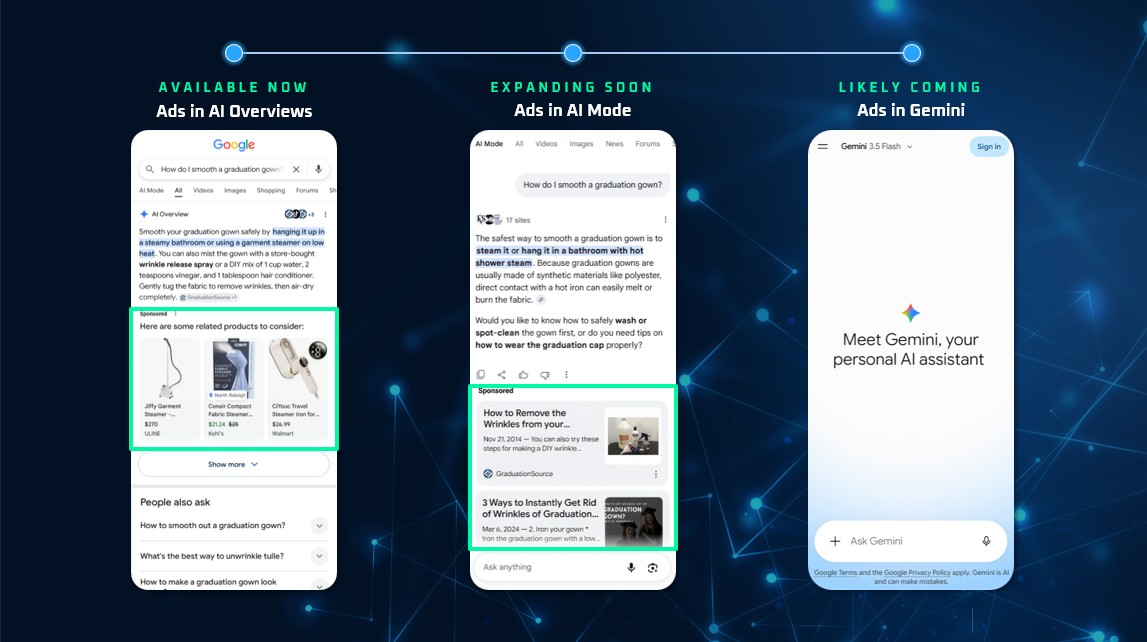
On the Google side, ads are rolling out across three surfaces at different stages of maturity:
- Ads in AI Overviews: Available now. This functions in line with regular Google Search, and it’s largely a GEO play, though ads can also appear as product listing ads.
- Ads in AI Mode: Expanding now. This is a separate search experience the user has to choose. There’s no guarantee of appearing here, but opting into Broad Match, AI Max, and Performance Max increases your odds.
- Ads in Gemini: Likely coming. Nothing official yet, but Google has signaled it’s open to it.
Google is also rolling out new conversational attributes in the product feed to help AI Mode and other LLMs understand your products more accurately and reduce the odds of a hallucinated product recommendation. These include pre-written FAQs, links to product documents like manuals or spec sheets, related-product mapping, popularity rankings, and item groups. As a bonus, filling these out also helps improve your Google Merchant Excellence Score.
How Users Phrase Queries in Google AI Mode
Understanding how people phrase queries to chatbots is important for your targeting strategy. Google’s own data on its AI Mode shows the most common opening words are conversational: “What,” “How,” “Can,” “Is,” and “I.” A common pattern is “How can I…” followed by topics like repairing a car, finding product manuals, or planning a vacation. Common follow-ups include “near me,” “replacement part,” and “in stock.”
That’s a meaningfully different shape than a typical search query, and it’s worth keeping in mind as you think about how your product and content data need to answer these more conversational, multi-step questions.
Where LLM Ads Fit in Your Media Mix
A natural question is: Where should this new channel sit. relative to what you’re already running? Right now, AI’s clearest strength is at the top and middle of the funnel, but here’s how we’re thinking about it:
- Awareness: AI’s strength is brand discovery, sitting alongside your existing Demand Gen, video reach, and programmatic awareness plays.
- Consideration: AI’s strength is product and brand validation, complementing branded search, Shopping/PMax, and ASC.
- Conversion: AI’s strength is purchase assistance, alongside PMax, non-brand search, and retargeting.
At this time AI advertising is not a replacement channel; it’s an addition. But it’s worth asking yourself: How many of your customers, a few years from now, might be using LLMs exclusively instead of traditional search? It’s a smart move to be an early adopter now, so you can refine your AI ad strategy and set your brand up for success in the future state of AI shopping, whatever that turns out to be.
How to Set Up an OpenAI Ads Manager Account
If you’re ready to test, OpenAI’s Ads Manager account structure will feel familiar if you’ve worked in any paid media platform:
- Account: Your advertiser name
- Campaign: Separated by product/service type and initiative
- Ad Group: Separated by objective and context hints
- Ad: Headline, description, and image
The concept unique to this platform is context hints: a description of the conversations, topics, or keywords where your products or services might be relevant. Think of it as a cousin of Search Themes in PPC or backend keywords in retail media – it guides matching without being an exact-match targeting rule. For example, a storage solutions brand might use hints like “space-saving storage ideas,” “storage furniture for apartments,” and “organizing cluttered spaces” in their account.
On bidding, CPM, CPC, and a new conversion-optimized CPC option are available now, with target CPA announced as “coming soon” and no word yet on target ROAS or maximize conversions/conversion value.
OpenAI’s Ads Manager also includes a few tools worth knowing about: change history (who changed what, and when), conversion setup, feed management (our Feeds team can help build this out for you), and secure first-party audience uploads.
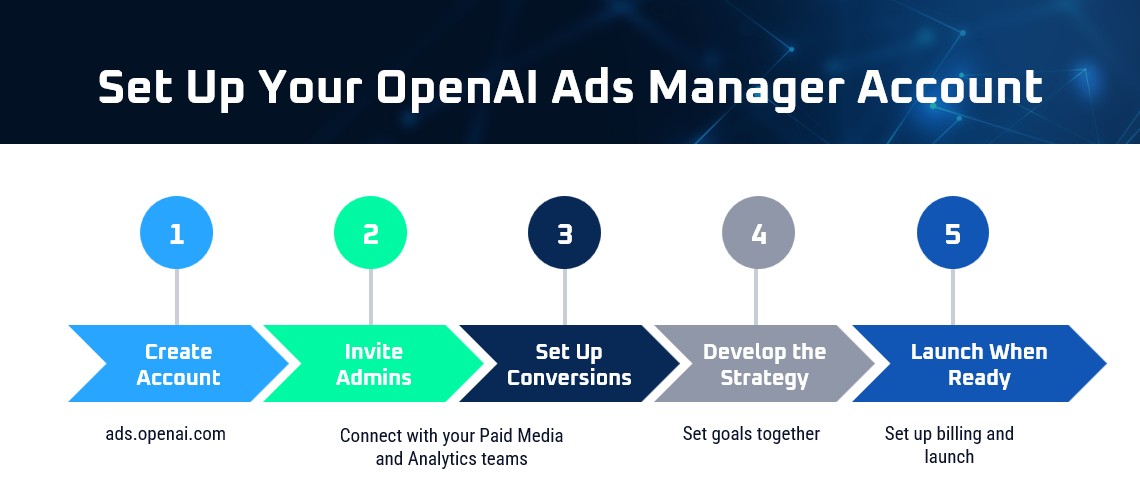
To get started, the process breaks down into five steps:
- Create your account at ads.openai.com.
- Invite admins (this is the time to loop in your paid media and analytics partners).
- Set up conversions.
- Develop your strategy and goals together, with your partners.
- Launch when ready.
Our advice: set the account up now, even if you’re not ready to launch a single ad yet.
How to Measure AI Ad Performance Today
Before you dive in, know what you’re signing up for on the reporting side. This is a genuinely different form of paid media, and it needs to be measured differently.
Performance insights are minimal right now. There’s currently no visibility into the specific queries that triggered your ads or user history. However, one thing you can control is to make sure UTM tagging is set up properly for GA4.
Reporting will mature. But for now, go in with realistic expectations about what you’ll be able to see.
Our Recommendation: How to Test AI Ads Without Overcommitting Budget
If you’re weighing whether it’s worth testing yet, here’s where we’d start:
- Hone your SEO and GEO first. Most chatbots have underlying search functionality, so how you show up in search results has a real influence on how you show up in LLM responses. AI needs to be able to find you, understand you, and choose you before it can ever recommend you in a paid placement.
- Budget conservatively. We suggest allocating somewhere around 1-3% of your current paid media spend to LLM ad testing to start.
- Think about the value of a click here differently than you would in traditional search, given the more limited measurement available today.
- Set up micro-conversion tracking where you can, to get some signals even without full-funnel visibility.
We’re on a new frontier, and that means testing with realistic expectations, not a full budget reallocation.
Need Expert Support?
Our paid media and SEO/GEO teams are already testing and learning in this space alongside our clients. If you’re trying to figure out whether LLM advertising belongs in your media mix – or want help getting your account and feed data ready for it – reach out to us.