
The days of chasing top 10 keyword rankings and getting as many backlinks as possible are over. Now that Google has added AI Overviews with potentially dozens of sources, all of which rank for position one, ranking well doesn’t always translate to share of voice, traffic, and revenue the way they used to. It’s time to rethink our priorities and our key performance indicators (KPIs).
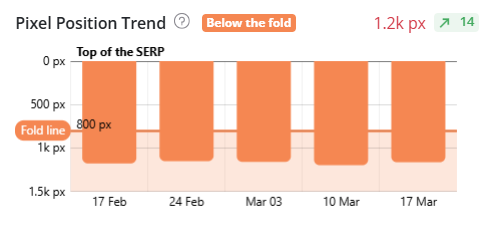
Did you know that even when an AI Overview is not triggered for a keyword, the first organic result can be pushed so far below the fold, under ads, organic shopping, People Also Ask, and other “features” that its click rate can still be low? For example, this Pixel Position Trend chart from Advanced Web Rankings belongs to a client that consistently ranks number one for an e-commerce keyword, and its organic listing is just as consistently below the fold now:
You need to move beyond rankings and backlinks to more advanced SEO KPIs to prove success to your stakeholders.
SEO Revenue
E-commerce websites exist to sell products and services, so it makes sense that revenue generated from SEO efforts should be a KPI. How much has your organic traffic contributed to your company’s bottom line? Have you achieved year-over-year growth?
If traffic has improved but revenue has not, you need to look at potential reasons. It’s possible that new users coming to the website are not easily finding what they are looking for, which may mean you need to add more helpful content to answer their questions and convince them to purchase from you. If users are falling at the last hurdle, your checkout page, you may need to get help from conversion rate optimization (CRO) experts. It’s also possible that the traffic coming to your website is not qualified, meaning visitors are not in the market to buy anything from you. To determine if the users coming to your site organically are qualified, look at your landing pages in Google Analytics to see which have high session numbers but few conversions. Are they informational pages that focus on tangential topics or have weak (or no) calls to action? If that’s the case, it might be time to take a hard look at the value of your informational content and how to improve it (but that’s a blog post for a different day).
Customer Acquisition Costs (CAC)
Another metric that can show how SEO is helping your bottom line is CAC. Are you aligning your organic search strategies to help lower the investment needed in paid advertising? Ideally, SEO and paid media ads are complementary tools. When costs per click rise for specific keywords, SEO may be able to take some of the burden from your PPC budget with optimized copy on high-quality landing pages.
Branded vs. Non-Branded Traffic
An established brand should rank well for its branded keywords, so the focus of SEO is typically to increase the brand’s discoverability for non-branded keywords. The more balanced the mix of traffic from branded vs. non-branded keywords, the more likely new customers will find you. This means focusing on keywords at all points on the customer’s journey to purchase, but especially on phrases with commercial and transactional intent.
On the other hand, a newer brand needs a boost in brand recognition. This is where navigational and informational keywords come into play. If your business sells exercise equipment for home use, ranking for “where to buy a treadmill” or “how to choose an elliptical machine” can improve the association of your brand name with those key terms. And as mentioned above, making the landing pages that answer those questions helpful and comprehensive with strong calls to action will help your revenue in the long run.
Share of Voice or Share of Market
How is your brand showing up in the SERPs overall? Are you ranking for your targeted keywords as well or better than your competitors? Is that metric improving year over year? Share of voice (SOV) or share of market (SOM) is straightforward to measure but can change frequently, depending on how crowded your industry is.
For example, there are a limited number of companies selling commercial HVAC systems, but a vast number of businesses selling inexpensive clothing. If you’re in a smaller market, with focused efforts, you should be able to capture more share of voice more easily than if you’re in a flooded marketplace. In more competitive markets, choose your top, direct competitors to focus on when growing SOV.
User Engagement Metrics
The first engagement metric most SEOs think about is click-through rate (CTR). Are users finding your organic search listing and seeing a title tag and meta description that entice them to click through to your website?
Once they click, do they stay? And if so, how long? Bounce rate can be a measure of the quality of a page in two ways, so use it with discernment. If the person was strictly looking for information, a bounce from an informational page could mean they found it easily and moved on with their day. But if they were looking for a product or service to solve a problem and didn’t find it on the page they landed on and then left your website, that could mean a few things:
- The page did not deliver on the promise of the title tag meta description
- The page did not answer the user’s question or convince them to make a purchase
- The page did not deliver a good user experience
Fortunately, there are ways to improve all these issues, and an experienced SEO team can help.
Long-Term Growth Indicators
In recent years, Google has downplayed the importance of backlinks in site quality assessments, but we still see evidence that high-quality, relevant backlinks from reputable sites can help prove a website worthy of sending users to. Today, with advancements in generative search (Gemini, Perplexity, ChatGPT), mentions of your brand on trustworthy sites can help as much as a backlink. This is where generative engine optimization (GEO) comes into play. At ROI Revolution, we understand the importance of helping those tools understand your brand and how it relates to the entities (a distinct and well-defined concept, object, or thing that is singular and unique, such as a person, place, brand, or idea) associated with it, so we’ve developed ways to improve your site’s GEO. The total number of pages that your site is indexed for can also be an indicator of long-term growth. An increase in indexed pages shows, at the very least, that Google thinks your site is worth surfacing in the SERPs. Not every indexed page is guaranteed to rank well, but by indexing a page, Google is showing some level of trust in your content.
Choose the SEO KPIs That Fit Your Business Goals
The best KPIs to focus on are the ones that match your business goals the best. If year-over-year revenue growth is your primary goal, then organic revenue makes sense. If improving your start-up company’s discoverability in the SERPs is top of the list, branded vs non-branded traffic, in addition to an overall increase in traffic, may be your priority. If you’re unsure how to narrow down to just one or two KPIs for SEO, get in touch with our team to start a conversation!