



In this edition: A spam update, spammer tactics, and important technical SEO advice.
Google Completes August 2026 Spam Update
On August 18th, Google launched the latest spam update, which took just three days to finish. It applies globally in all languages. The tech giant said this was a “normal update,” meaning it was meant to improve its ability to catch new types of spam and enforce its spam policies. If you think your website might have been affected by this update, reach out to the ROI Revolution SEO team to discuss your concerns.
Google Rolls Out Gemini 3.7 Flash to Search (AI Mode)
Google is upgrading Search’s AI capabilities with its latest “workhorse” model, Gemini 3.7 Flash. Here’s what SEOs need to know:
- Current Access: Currently available globally in English for Google AI Pro & Ultra subscribers only. Users can manually select the new model within Search’s AI Mode.
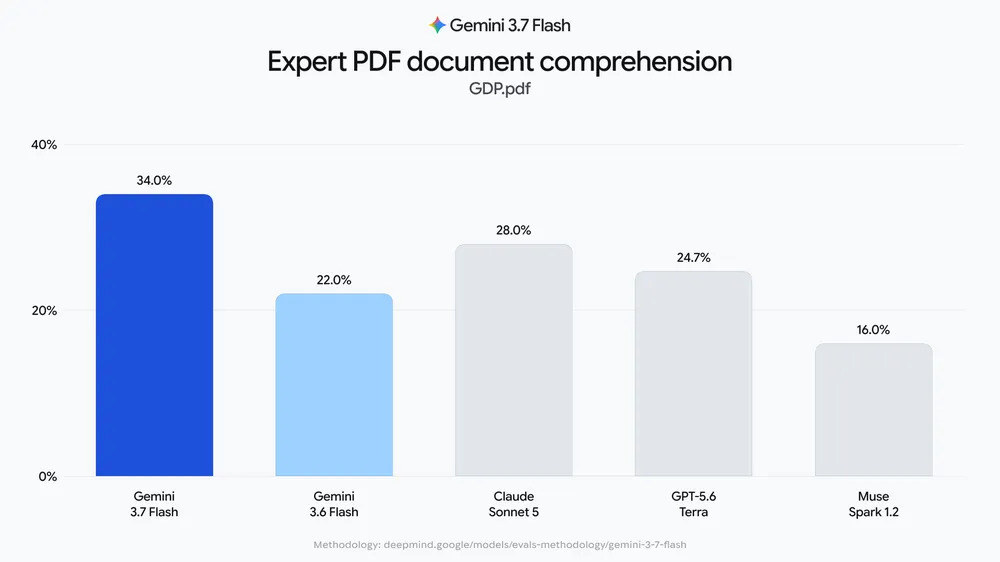
- Key Upgrades: Google notes this model is its “most intelligent workhorse model yet for coding and agents.” It is significantly better at understanding user intent and following detailed prompts. It also significantly outperforms 3.6 Flash on the GDP.pdf benchmark (34.0% vs. 22.0%), an evaluation for testing a model’s ability to process complex documents.
- What’s Next: Expect Gemini 3.7 Flash to eventually replace 3.5 Flash-Lite for the broader, free search audience as Google scales the rollout.
Source: blog.google
Misconfiguring Cloudflare Can Significantly Hurt Your SEO
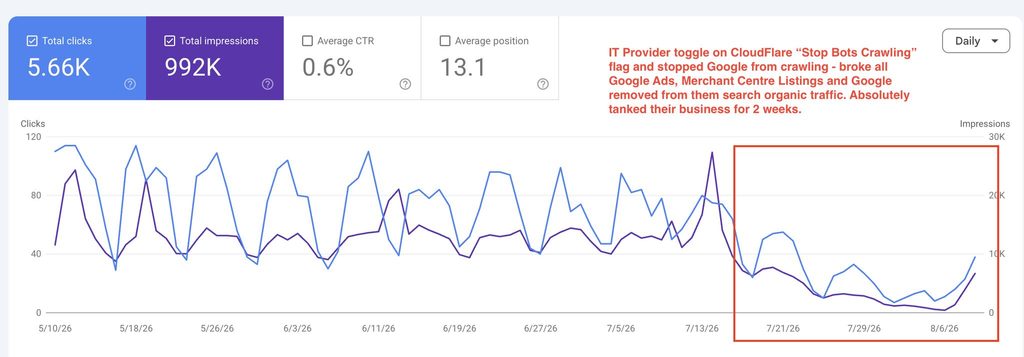
A surge in CDN misconfigurations is accidentally blocking Googlebot, leading to sudden, catastrophic drops in rankings, lost indexation, and broken Google Ads campaigns. Driven by efforts to block aggressive AI scrapers, site owners using Cloudflare and similar CDNs are turning on blanket “crawl control” settings without realizing they are locking out legitimate search engines. Double-check your firewall rules and bot protection settings immediately to ensure search crawlers aren’t caught in the crossfire.
Brodie Clark posted an example of how this impacted a site on LinkedIn:
Source: Brody Clark, LinkedIn
This is more and more common these days as websites try to manage the increase in AI bot activity. Make sure your CDN explicitly whitelists these essential search engine bots:
- Googlebot: Primary desktop & mobile crawler for main search indexing
- Google-InspectionTool: Powers Search Console’s Live URL Inspection tool
- AdsBot-Google/AdsBot-Google-Mobile: Checks landing page quality & policy compliance for Google Ads
- Storebot-Google: Crawls product pages for Google Merchant Center/Shopping
- Bingbot: Microsoft Bing search indexer
- Applebot: Powers Siri, Spotlight, and Apple Search/Intelligence
- DuckDuckBot: DuckDuckGo web crawler
- YandexBot: Yandex search crawler
- Slurp: Yahoo’s native crawler used for Yahoo News, Finance, partner content, and mobile indexing
JavaScript links can make your pages invisible to AI search
Nearly every modern website uses JavaScript to some extent, with degrees of variability and functionality use cases. However, depending on the way your site is set up, your content and products may not be visible to AI bots. As a result, you could be excluded from AI search.
Research by Vinicius Stanula published on Search Engine Land shows that linking to content exclusively from client-side rendered JavaScript led to AI bots being unable to discover that content. In his research, every page linked to in the raw HTML was found by at least one crawler. Content linked to by JavaScript was only reached by Google’s bots, mostly by GoogleOther, which does not build the index. Even this one bot only managed to discover 42-67% of the content, depending on its location in the site hierarchy depth.
Relying on JavaScript linking can lead to huge swaths of your website being excluded from ChatGPT and other LLMs off the starting line. To get around this, ensure that JavaScript is not your only way of linking; important pages should always have at least one standard HTML link (<a href=”/page”>Text</a>) that links to them.
Google Adding AI and Agentic Experiences to Google Ads and Analytics
Earlier this month, Google announced new features in Google Ads and Analytics meant “to simply your workflow and expedite your path to business growth.”
- Analytics AI Overviews: Coming soon to GA4 at the top of the page, you will see an instant summary of important updates since you last logged in, including changes in traffic and seasonal peaks in sales.
- Ask Advisor in Analytics: Ask Advisor was rolled out earlier this year to simplify the process of creating custom reports. Now, with this update, you can ask for benchmarking data to compare your campaign performance against anonymized averages from similar businesses.
- Insights cards in Google Ads: See AI-powered insights to help make informed strategy decisions and use a prompt box to ask for custom insights.
- Clearly visualize data: In both Ads and GA4 (also coming soon), ” you can transform raw data into clear visualizations with simple text prompts.”
The bottom line: You no longer need to be a data guru to find useful data fast in Ads and Analytics, but you still need to know how to ask the right questions.
Google Treats Site Search Box Abuse as if a Site Has Been Hacked
Most large websites have a search box that allows users to easily find products, articles, or other pages on a website. It’s a great feature for customer experience, but it can be easily abused if not set up correctly. In a recent Search Off the Record podcast, Googlers Martin Splitt and John Mueller explain that spammers may input URLs, keywords, phone numbers, and other data into a search box to create an infinite number of URLs pointing to their spammy sites.
Google can catch this issue algorithmically, but if it does, it will treat the website as if it’s been hacked. As a result, the site will feel the effects of being considered lower quality – mostly by losing rankings. How do you avoid being the victim of site-search spamming? Mueller and Splitt recommend using a broad rule in robots.txt to block any URLs created by site searches from being indexed.
Impression Decline in GSC Was a Logging Issue
In the “it’s a bug, not a feature” news, on August 12th, Google Search Console users reported sharp declines in impressions in the new Generative AI features report. John Mueller confirmed that Google was aware of the logging issue and was working to correct it. By August 20th, the error was corrected, but if you see a steep decline and rebound during those dates in your own GSC dashboard, it’s likely your data was affected by the logging issue.
Expired Google X Accounts Being Commandeered by SEOs
It’s not illegal, but maybe it should be: Many Googlers stopped using X when Elon Musk bought Twitter and changed its name. Those accounts were allowed to expire, and the handles became available for others to use. Barry Schwartz of SE Roundtable warned readers that Martin Splitt’s account (@g33konaut) is one of those being used by someone else now, who is presumably hoping Splitt’s followers continue to give that handle the clout Splitt had deservedly earned.
The takeaway: Be cautious about who you’re following on X, and make sure the accounts you take advice from are verified.
ChatGPT Is Citing Reddit Less Often
Generative AI answers are changing constantly as the models used to create them are tweaked and improved. Case in point: According to Promptwatch, Reddit steadily held a 3.8% share of ChatGPT citations for about three weeks. Then, on August 14th, that share shrank to about 0.5%. The platform is also seeing a decline in citations by AI Overviews and AI Mode, although not as dramatic.
Some SEOs are speculating that ChatGPT and Google are trying to get in front of the abuse that’s becoming rampant on Reddit, in which people are trying to manipulate AI search citations by planting quotable information about their businesses on Reddit threads. This tactic risks those users being banned by subreddit administrators, and is an even worse idea now that citations aren’t as likely.