
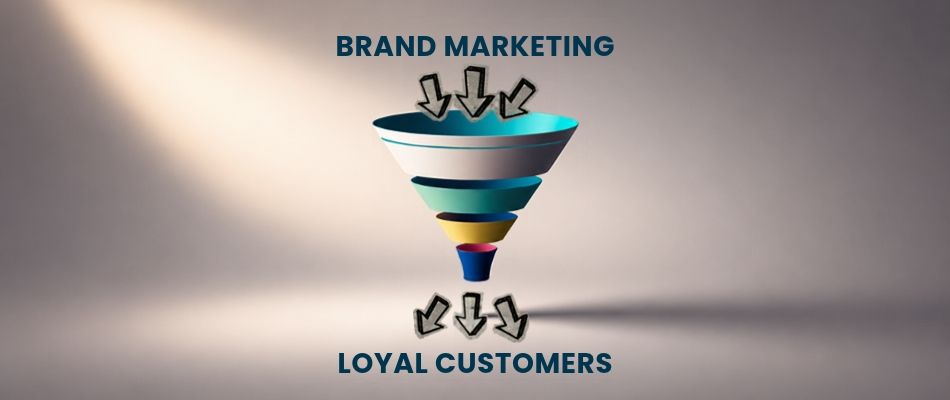
TL;DR: Brand marketing for ecommerce is the work of shaping how shoppers perceive, remember, and trust your brand before they’re ready to buy. Only about 5% of buyers in a category are in-market at any time. Brand marketing reaches the other 95%, so they think of you first when they’re ready, and your performance campaigns have more shoppers to convert.
Ecommerce brands that cut brand spend to chase short-term ROAS end up shrinking the pool of shoppers they can convert later.
What is Brand Marketing for Ecommerce?
Brand marketing is the work of shaping how people perceive, remember, and feel about your brand over time, so that when they’re ready to buy, they choose you. It covers your mission and value props, the places you show up, and the design, voice, and personality that keep you recognizable everywhere a customer sees you.
Examples of brand marketing initiatives are upper-funnel video and CTV campaigns, sponsorships, thought leadership content, PR, organic social, and brand identity work like messaging and visual guidelines. The success of brand marketing is usually measured in awareness, recall, preference, and trust, rather than conversions or ROAS.
Branding vs. Marketing: What’s the Difference?
The two terms sometimes get mixed up, which can lead to fuzzy business goals and marketing budgets.
Branding is who you are. It’s your name, mission, value props, visual identity, and voice. It answers the question “Why this company?”
Marketing is how you get in front of people and move them to act. It’s your channels, campaigns, ads, emails, and content.
Brand marketing sits where the two meet: it uses your marketing channels to build the brand itself.
How Brand Marketing Differs from Product Marketing
Product marketing sells a specific product. It focuses on features, pricing, launches, and why this item beats the one next to it. It mostly speaks to shoppers who are already in the market.
Brand marketing sells the company behind every product. It gives shoppers a reason to remember you and trust your brand even before they’re actively shopping for a specific item.
Take a truck parts retailer. A Shopping ad for a specific headlight assembly is product marketing. Showing up consistently in the YouTube how-to videos where truck owners learn to swap their own headlights is brand marketing. One captures demand that already exists. The other creates demand you’ll capture later.
You need both. Strong brand marketing makes your product marketing work harder, because shoppers already know and trust the name on the ad.
How Brand Marketing and Performance Marketing Work Together
A lot of marketing programs treat brand marketing as something separate from performance marketing. That split was a theme at Adweek’s Brandweek 2026, which David attended, and it’s a divide we work with our ecommerce clients to bridge.
Brand investment drives revenue. It just takes a longer path to get there:
- Awareness of your brand leads to
- Preference for your brand, which leads to
- Demand, which leads to
- Revenue
In their research for the Institute of Practitioners in Advertising, The Long and the Short of It, Les Binet and Peter Field found that the best balance is, on average, about 60% of marketing spend on brand building and 40% on sales activation, though it varies by category.
Many brands have the opposite mindset right now: get the revenue and ROAS today. But that focus can come at the cost of future growth. Short-term wins often lead to diminished long-term results.
Brand marketing and performance marketing do different jobs in the same funnel:
| Brand Marketing | Performance Marketing | |
| Main job | Creates demand you’ll capture later | Captures demand that already exists |
| Who it reaches | The 95% who fit but aren’t ready to buy yet | The 5% who are in-market now |
| Typical channels | Organic YouTube and social, paid social for reach, programmatic and CTV, PR | Retargeting, branded search, bottom-of-funnel Shopping |
| How to judge it | Reach into new audiences, branded search growth, repeat customer rate | Conversions and ROAS |
| Time to show results | Longer path: awareness, then preference, then demand, then revenue | Shows up on a same-day ROAS report |
The 95:5 Rule and Why It Matters for Your Budget
The 95:5 rule, from John Dawes of the Ehrenberg-Bass Institute, explains why a ROAS-only approach eventually stalls.
At any given time, about 5% of your total addressable market is in-market to buy what you sell. The other 95% are a good fit for what you offer but aren’t ready to buy yet. Dawes built the rule around B2B buying cycles, and the exact split varies by category, but the takeaway carries over to ecommerce: most of the people who will buy from you aren’t shopping today.
That 95% is where your future customers come from. If you aren’t reaching them now, they won’t think of you when it’s time to buy.
If every dollar goes to retargeting, branded search, and bottom-of-funnel Shopping campaigns, you’re clearing out an already limited pool of buyers without adding anyone new to it. Performance looks great for a while, and then it stalls. The goal is to balance demand capture with demand generation all the time, so your funnel keeps refilling.
For leaders setting budgets and KPIs, this is the key tradeoff to be aware of. Spend that looks less efficient on a same-day ROAS report may be exactly what keeps next quarter’s performance campaigns supplied with shoppers. It’s important to judge brand marketing investment on its own terms, including reach into new audiences, branded search growth, and repeat customer rate. Then give it enough time to show results.
Spend that looks less efficient on a same-day ROAS report may be exactly what keeps next quarter’s performance campaigns supplied with shoppers.
Re-Examine Who You Are and Who You’re For
Most businesses define their mission and value props when they launch. Many are good at it. The problem is that often, those definitions never get re-examined.
Audiences shift over time, and your messaging should shift to meet the market where it is. A few questions worth revisiting regularly:
- Am I speaking to the right people in the right way?
- Where does my audience spend time in the digital ecosystem?
- How are they thinking about and searching for what I sell?
- Am I highlighting the things that matter most to them?
Then layer in consistency. Your design, brand voice, and persona should stay recognizable at every touchpoint, so the people you want to reach see the same brand throughout their journey.
Show Up Where You Have Permission to Be
A big part of brand marketing is figuring out where you have permission to show up. Where are the conversations about your category happening, and where does it make sense for your brand to join them?
Audience research tools can show you exactly where your customers spend time. Search is a given, since people are actively looking for what you sell. But look beyond that to where organic conversations happen.
Let’s return to our ecommerce example. Say you sell truck parts. Your audience may index heavily on YouTube, where people go to learn how to mount a new bumper or switch out a headlight. Showing up on those specific channels puts you in front of an extremely relevant audience.
Now picture that same truck parts brand running ads next to political content on YouTube. Same platform, but the placement means nothing to the viewer. Relevance is what makes brand exposure pay off.
The Channels That Build Your Brand
Different channels play different roles in brand building:
- Organic: Your organic presence is the most durable way to build brand equity. That includes your organic YouTube and social accounts and your website. Your site needs to make it clear who you are, what you provide, and why it’s valuable. Put yourself in your customer’s shoes: name the problem they have, and show how your product solves it.
- Search: Search is an active channel. When your structure and strategy target the right users with relevant content, the people seeing your ads are looking for what you offer.
- Paid social: Social is a passive channel. You’re interrupting someone in the middle of doing something else. Meta is a great tool for reach, and TikTok, Snapchat, Pinterest, and Reddit can all work depending on where your customers are. LinkedIn has a strong B2B use case.
- Programmatic: Programmatic advertising is opening up TV to more brands. Streaming made up 45.3% of ad-supported TV viewing time in Q2 2025, per Nielsen data cited by eMarketer, and as CTV ad supply has grown, CTV ad prices have come down. Digiday reports that more TV inventory can now be bought programmatically, which is lowering the barrier to entry for small and mid-sized advertisers. Like social, it’s a passive channel that excels at reach, getting you in front of shoppers at an efficient CPM (cost per 1,000 ad impressions).
Passive channels like social and programmatic are how you should fuel the top of the funnel. Targeting can be looser because you aren’t only chasing people who are already in market, but it should still stay relevant.
Showing up in multiple places matters because consumers are more budget-conscious and deliberate than they used to be, and the consideration phase is more fragmented. Repeated, consistent exposure across the marketing ecosystem adds up over that longer path to purchase.
Trust Pays Off on the Bottom Line
Trust is where brand marketing most clearly shows up as performance marketing. Salsify’s Ecommerce Pulse Report: Q4 2025 found that nearly nine out of 10 shoppers will pay more for products from a brand they trust.
Trust also makes your brand more resilient when the economy tightens. As NielsenIQ notes, cautious shoppers lean on brands they trust to lower the risk of a bad purchase, so strong brands tend to hold share while competitors are forced to discount. When shoppers trust you:
- They’re more likely to buy from you.
- They’re more likely to come back, which increases lifetime value.
- Repeat purchases cost less, because you’ve already paid to acquire that customer.
Every one of those affects margin, which is the number your CFO cares about.
Talk Through Your Brand and Performance Mix
If your marketing plan is built entirely around this week’s ROAS, you may be leaving your future pipeline empty. ROI Revolution’s Paid Social, Programmatic Advertising, and GEO + SEO teams help ecommerce brands reach the right audiences, show up consistently in the right places, and turn brand awareness into long-term, profitable growth.
Contact our team to talk through how brand and performance can work together in your marketing plan.
Frequently Asked Questions (FAQ Schema)
What is brand marketing for ecommerce?
Brand marketing for ecommerce is the work of shaping how shoppers perceive, remember, and trust an online brand before they’re ready to buy. It includes upper-funnel video and CTV, organic social, PR, thought leadership, and consistent messaging and design. Its goal is to make shoppers think of your brand first when they enter the market.
What is the difference between brand marketing and performance marketing?
Performance marketing captures demand that already exists, through channels like retargeting, branded search, and Shopping ads, and is judged on conversions and ROAS. Brand marketing creates future demand by reaching shoppers who aren’t buying yet. Ecommerce brands need both, because brand marketing keeps refilling the pool of shoppers that performance campaigns convert.
What is the 95:5 rule in marketing?
The 95:5 rule, from John Dawes of the Ehrenberg-Bass Institute, estimates that only about 5% of a category’s buyers are in-market at any given time. The other 95% are a good fit but aren’t ready to buy yet. Dawes built it around B2B buying cycles, and the exact split varies by category.
How much of a marketing budget should go to brand building?
:es Binet and Peter Field’s research for the IPA, The Long and the Short of It, found that the best balance is, on average, about 60% of marketing spend on brand building and 40% on sales activation. They note the right split varies by category, so treat 60:40 as a starting benchmark, not a fixed rule.
How do you measure brand marketing?
Brand marketing is usually measured in awareness, recall, preference, and trust, rather than same-day conversions or ROAS. Practical metrics include reach into new audiences, branded search growth, and repeat customer rate. Give brand investment enough time to show results before judging it.
Which channels build brand awareness for ecommerce brands?
Organic channels, including your website, YouTube, and social accounts, are the most durable way to build brand equity. Passive paid channels like paid social and programmatic advertising (including CTV) are strong for reach at the top of the funnel. Search captures the demand those channels create.
Sources
Les Binet and Peter Field, Institute of Practitioners in Advertising (IPA), The Long and the Short of It: Balancing Short and Long-Term Marketing Strategies (2013). Full-text PDF, see page 9.
John Dawes, The 95:5 Rule
Digiday, Programmatic advertising on TV is set to increase this year
eMarketer: Digital Video and Forecast Trends Q4 2025
NielsenIQ: Brand Resilience: How Strong Brands Build Trust and Withstand Economic Pressure