
In this edition: New AI Reporting in GSC and Bing Webmaster Tools, Agentic Browsing,
and More!
New Google Search Console AI performance Reports
Google is rolling out a highly anticipated update: dedicated Search Generative AI performance reports in Search Console. As of publication time, this is only rolling out to a subset of websites for testing. The new reports give site owners a dedicated view of how their content performs in generative features like AI Overviews, AI Mode, and AI-driven Discover feeds.
What you can track:
- Impressions: How often your URLs appear in generative AI features.
- Pages: Exactly which URLs are being surfaced by AI.
- Granular Data: Country and device breakdowns, plus performance over time with hourly, daily, weekly, and monthly tracking.
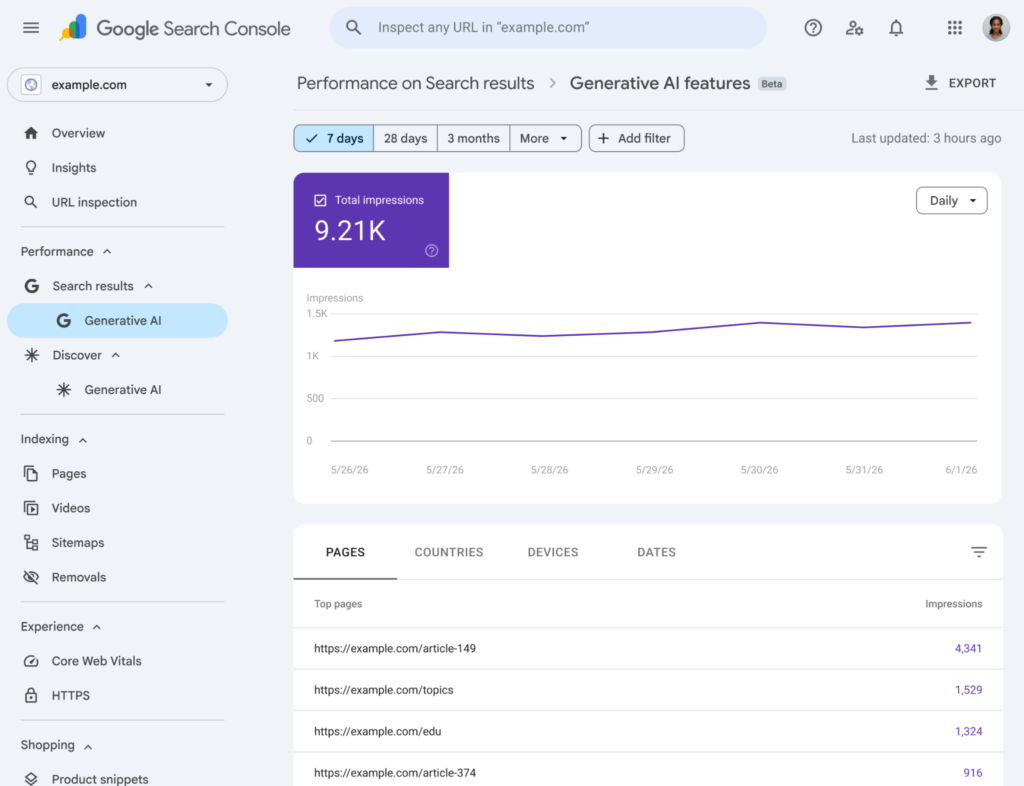
Source: developers.google.com
Google says they plan to add more metrics over time based on webmaster feedback before pushing the reports out to everyone. Currently we are only seeing this report available on domains that have an international presence
Bing Webmaster Tools Expands AI Performance Report
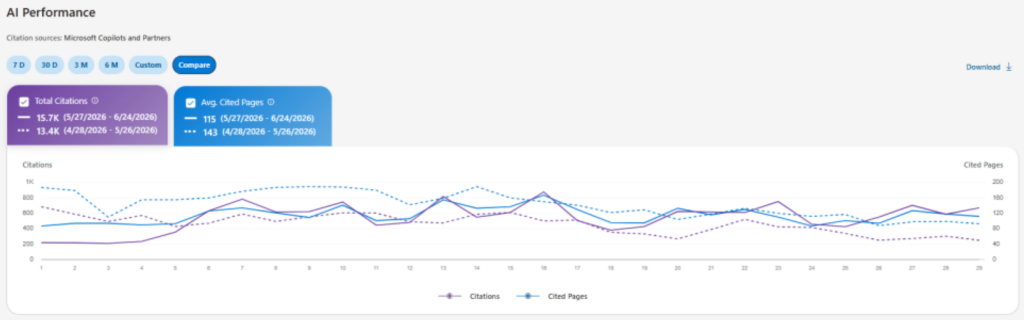
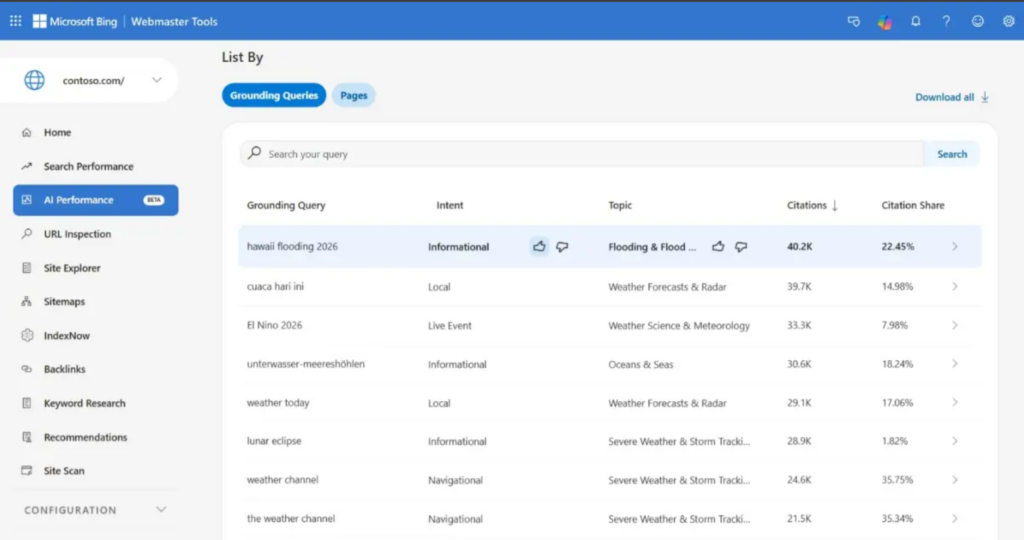
Earlier this year, Bing introduced “AI Performance” into its Webmaster Tools, allowing site owners and SEOs to see the queries and pages their websites were showing up for in Microsoft CoPilot and partners. As of June 16th, we can now see even more data, including intents, topics, and citation share, and we have the ability to compare time periods.
- Intents: Shows the reasons your site may be used in grounding queries such as informational, commercial, navigational, learn and solve, research, creation, local, and more.
- Topics: Groups related grounding queries into thematic clusters, like shopping, returns, and promotions.
- Citation Share: Provides an understanding of the percentage of citations attributed to your site out of all cites for the same grounding query.
- Compare: Allows you to overlay a previous time period directly on top of the current one.
Here’s an example of “Compare”:
And an example, provided by Bing, of the new table:
As SEOs, we’re excited about the additional insights these tools will provide us!
UK Demands Search Transparency from Google
In a massive move for search transparency, the UK’s Competition and Markets Authority (CMA) has ordered Google to come clean about how search results are ranked. Under two new conduct requirements, Google must:
- Explain the Algorithm: Provide clear transparency to businesses on how organic rankings and AI Overviews work, proving its organic ranking algorithms are objective and non-discriminatory (within 6 months).
- Advance Notice for Updates: Provide advance notice before launching significant ranking updates. Google must also establish a dispute process for website owners.
- Data Portability: Allow users to port their search data to authorized third parties. (within 3 months).
While political bodies have tried to force Google’s hand before, the strict deadlines and inclusion of AI Overviews make this a space to watch closely. If enforced successfully, this could fundamentally change how search experts prepare for and dispute core algorithm updates.
Google Launches Information Agents
Google AI Ultra subscribers can now set up information agents in AI Mode. In an X thread on June 12th, vice-president of product for Google Search, Robby Stein, said, “Just ask AI Mode to keep you updated on any topic, and your agent will work around the clock on your behalf to send detailed updates and links to the web the moment new info is available.” The feature will be expanded to additional users over the summer.
What does this mean for website owners? If you want your site to be shown to information agents, it needs to be easily crawlable by them (see #5 below!). The move is especially important for sites that regularly publish news items that might appeal to specific audiences, like investors or news publishers, but could also be helpful for ecommerce businesses.
Google Lighthouse Has a New Agentic Browsing Score
Google Lighthouse 13.3 introduces an official Agentic Browsing category, designed to audit how well your website performs for AI agents and automated bots.
The Agentic Browsing category is an experimental audit built directly into Google Lighthouse. Instead of giving your site a traditional 0–100 score, it provides a fractional pass ratio (e.g., “3 of 5 audits passed”). Because the technical standards for the “agentic web” are still actively forming, Google is using this ratio to offer optimization signals rather than a rigid, definitive ranking.
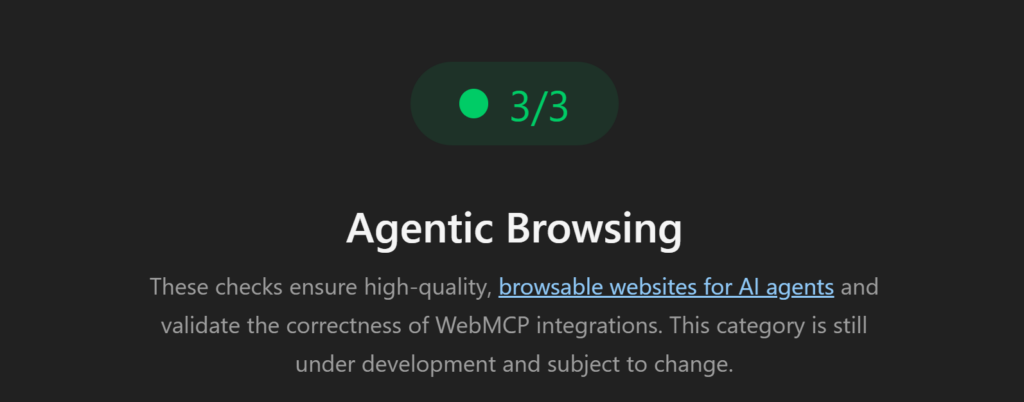
You can test this out on your website in a few different ways:
- PageSpeed Insights: Simply enter your test URL; It automatically runs the 13.3 configuration.
- Chrome DevTools: Open DevTools, go to the Lighthouse tab, and click Analyze page load. On Chrome 150 (currently in beta), the category is on by default.
Zero-Click Searches Continue to Grow
In a report released by Sparktoro and Similarweb, new data shows that in the first four months of 2026, 68% of searches on Google ended without a click. That number is up from 60% in 2024 (and 50% in 2019).
Of the 32% of searches that do end with a click,
- 66% go to organic entries
- 27% to AI Mode, YouTube, Maps, Images, News, or another Alphabet-owned property (Google’s parent company)
- 6% go to a paid ad.
That means for every 1,000 US Google searches, only 232 clicks go to the organic listings.
So, is SEO dead? Of course not! This data simply explains why organic traffic is down across industries, and why looking at KPIs (such as AI visibility and average rank) provides a more holistic view of your total organic search (SEO & GEO) presence.
Google Updates AI Documentation on LLMS.txt Files
Just last month, Google released its first real documentation on how to optimize for generative AI search. That document has since been updated to specifically say that “Google Search does not use” file types created specifically for LLMs, including AI text files, structured data markup or Markdown.
There’s nuance in this list of “things you can ignore,” but the key takeaway is that you do not need a separate, AI-specific technical layer to show up in Google Search AI. It doesn’t mean that these files might not help you in other ways (after all, schema markup can enable rich results), just that they aren’t required.
Reading between the lines for clients who are implementing LLMS.txt files: doing so will not harm or help you in Google Search. The debate is ongoing about whether they help with generative engines like Claude, ChatGPT, and others. Our take: if you want to use an LLMS.txt file on your site, great! But it’s not a requirement for Google.
Google: Don’t Buy Brand Mentions
In everything-old-is-new-again news: Googler Gary Illyes reportedly warned Search Central Live Sydney 2026 attendees not to buy or manipulate brand mentions to try to manipulate AI responses, AI Overviews, or AI Mode.
The notice comes after a popular AI software platform started to promote a way to automate the process of buying brand mentions for that purpose. The tactic is similar to the inauthentic link building practices of a decade ago, and that did not end well for websites who employed them. In short, save your hard-earned money and invest it in authentic brand building.