

1. Majority of ChatGPT Citations Are from the Top 1/3 of the Page
A recent study of over 1 million ChatGPT answers and 18K verified citations further supports what many SEOs have been saying about how to write for better AI visibility: don’t bury the lede, put your key insights at the top of the page. The analysis revealed that 44.2% of citations come from the first third of the page. Additionally, commonalities between cited URLS include the following: definitive language, conversational Q&A structure, entity richness, balanced sentiment, and “business-grade” clarity. Read the full paper for more insights and tips.
2. Changes from the Google February 2026 Discover Update
Google’s recent Discover algorithm update impacted the way content is surfaced in three distinct ways:
- Users will be shown more locally relevant content, meaning non-US publishers will be less likely to be surfaced in the US.
- Sensational or “clickbait-y” content will be targeted for reduced visibility.
- Content that is more in-depth, original, recent, and demonstrates expertise on a given topic will be surfaced more often.
3. Search Console Adds AI-Powered Config & Branded Query Filter
Google Search Console has recently updated its interface to add two new capabilities – but be aware that each comes with limitations.
AI-Powered Configuration
This feature is marketed as a way to improve efficiency during analysis via AI-enabled features, including:
- Filter Application: “Smart” filtering by query, page, country, device, search appearance, or date range.
- Configuration Comparison: Automate setup for complex comparisons, like custom date ranges.
- Metric Selection: Chooses which GSC metric to display based on your prompt (Clicks, Impressions, Average CTR, or Average Position).
Here’s what to watch out for based on documented limitations:
- This configuration is only available for the Performance report for Search results, not Discover or News reports.
- Due to the nature of AI, all outputs should be reviewed for accuracy and to be sure they actually match your request.
- Since it’s designed specifically for configurations, the configuration is limited to filtering, comparisons, and metrics – the AI assistance doesn’t cover actions like sorting or exporting the data.
Branded Query Filter
The new filter allows users to quickly review traffic that is branded vs. nonbranded. The report was first introduced in November and is now available for all sites. It works by filtering for your brand name or closely associated products, or by filtering for nonbranded queries so you can see more easily how each group is performing.
Based on Google’s documentation, here are two limitations to be aware of:
- The filter is only available for top level properties, not URL paths or subdomains.
- It’s only available for sites with enough volume and impressions for Google’s signals.
Testing this ourselves, we’ve noticed an additional limitation: the report is not retroactive even though the filter is based on a custom regex.
4. Google VP Reminds Us Why Search is Fundamental to AI’s Answers
Vice-President of Product at Google Search, Robby Stein, talked about how they’ve taught AI Mode to link out to sources using the query fan out technique, why you don’t need to use AI for everything, and how conversational search is the fastest growing version of Search.
The entire interview with Zain Kahn, published on X, is worth watching, but at about the 8:35 mark, Kahn asks Stein, “How do you see SEO changing from Google’s perspective as people start doing more complex searches now on Google, the browser, and how does that impact Google from a ranking perspective…?”
Stein’s answer hits home and shows why SEO is foundational to GEO. He said, “I think the good news is that, under the hood, a lot of these AI systems that are trying to get real time information and context are actually effectively using Google. And so, you can think of Google Search as a way for an AI model to also Google on your behalf. It’s kind of like a research agent in that respect.”
He continued by explaining how the model will take one user question and break it into several related questions (the query fan out) and then use Google to find the answers. The websites that show up in those searches are the ones the models will source and link to.
5. Anthropic Updates Claude Bot Documentation
Claude is one AI chatbot that does its own research, and website owners should be aware of the ways in which the AI crawls their sites and how to block the bots, should they want to. Anthropic updated its documentation to clarify this information.
There are three bots employed by Claude to crawl websites for information:
- ClaudeBot crawls sites for training data and blocking it signals the website’s information should be excluded from future training sets.
- Claude-User crawls websites for answers to user questions. Disabling this bot may limit your site’s visibility in its answers.
- Claude-SearchBot analyzes web content to enhance the relevance and accuracy of its answers. Blocking this one may also limit your site’s visibility and the accuracy of its answers about your business.
The best way to block any of these bots is by using directives in your robots.txt file because Anthropic says it will respect those directives, and it will not try to circumvent CAPTCHAs.
6. Google Publishes FAQs about Web Crawling
After three decades of crawling the web for answers to user queries, Google has decided it’s time to answer common questions about how it works. Here are a few highlights:
- For sites that change often, such as news publishers, Google may crawl the site every few minutes. For sites that don’t update often, it could take months. Websites that update less frequently can use sitemap files to tell Google about new and updated pages.
- Frequent crawling is a sign that there is user demand for fresh content from your site and that Google recognizes that the site is updated often. Ecommerce sites are an example of websites that are crawled more frequently.
- By default, if a web page is not accessible to the open web, Google’s bots will not crawl it. They respect paywalls and robots.txt files.
7. Self-Serving Listicles Are Suffering Algorithmic Hits
Websites of all sizes that are trying to capture citations from LLMs with thin content and self-serving listicles (for example, top ten lists that rank their own product as number one) are being hit by Google’s algorithms and quickly losing position in the SERPs. In some cases, a few seem to have been hit with manual actions. Observations are ongoing, and you can find them on social media from SEOs like Lily Ray and Glenn Gabe, who are posting examples almost daily.
If you read the summary of Google VP Robby Stein’s interview above, you’ll understand why publishing content that risks an algorithmic hit is not a good long-term strategy. If Google won’t show your site in the SERPs, it’s unlikely to be seen by the LLMs. Stick with high-quality, helpful content that answers user questions concisely and comprehensively as a long-term strategy, and you’ll have a much better chance of being shown to users of most AI tools.
8. Google Is Rolling Out “Ask Maps”
On March 12th, Google announced big changes are coming soon to iOS and Android users of Google Maps. The tech company is incorporating Gemini into its maps app to create a more helpful, immersive experience. Ask Maps is rolling out to users and will be available on the app under the search bar.
When you tap the button, you can ask your question about an area or a trip the same way you would ask a friend. For example, “Historic locations between here and Carolina Beach, NC” Using Gemini, the app should search out locations you might be interested in and provide their information such as business hours and reviews, along with their proximity to your route.
Knowing there are several historic sites between Raleigh and Carolina Beach, we recently tried this with less than stellar results:
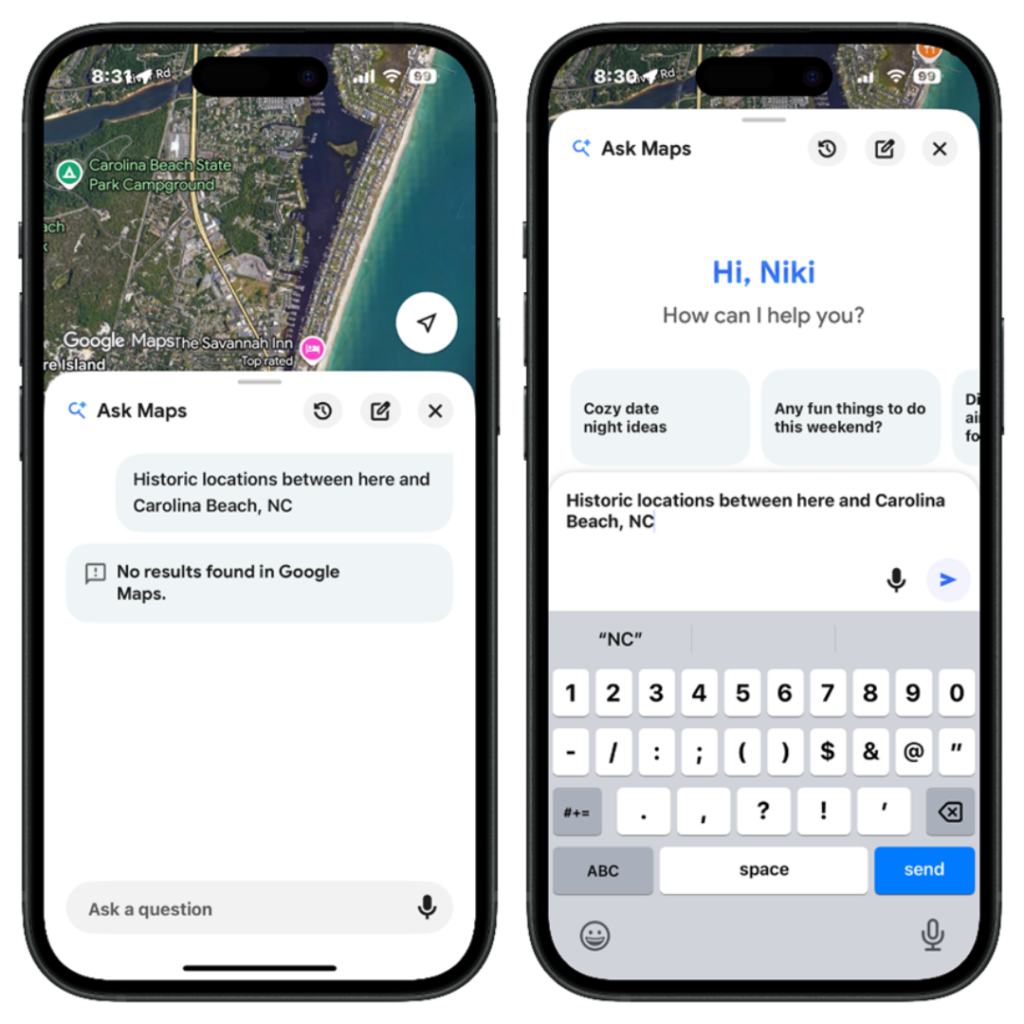
We’re hoping the function improves.
Additionally, Google is trying to make the navigation interface more helpful with Immersive Navigation. The update will show more of your route on the screen and warn you of tricky turns or lane changes in advance. It will also provide trade-offs for different routes, such as a longer drive time for less traffic, or paying a toll to get to your destination faster.
While this is exciting news from a user’s perspective, it also means that if you’re a business with a brick-and-mortar location, ensuring your Google business profile is up to date is more important than ever. Check that your business hours and location are accurate, especially if it’s been a while since you created your profile.
ICYMI: Recent SEO Blog Posts
How to Optimize for AI Search Engines: The 2026 Guide to Generative Engine Optimization (GEO)