

TL;DR: Google’s new Conversational Attributes and AI Performance Insights signal a shift from keyword-based product feeds to context-driven product discovery in AI-powered shopping.
The ecommerce landscape is undergoing major change, and retailers are already seeing the impact.
Consumers are increasingly turning to conversational AI tools to research products, compare options, and inform purchase decisions. Rather than relying solely on traditional keyword searches, shoppers are asking detailed questions and expecting AI-powered platforms to deliver highly relevant recommendations.
As this behavior continues to grow, Google is rapidly adapting its ecosystem to meet the moment. Google Merchant Center recently announced two updates that will fundamentally change how merchants optimize product feeds for AI-powered shopping experiences: Conversational Attributes and AI Performance Insights.
For ecommerce brands and marketers, this isn’t just another update to Google Merchant Center. It represents a critical shift in how products are understood, surfaced, and measured across Google’s AI-driven experiences, including AI Mode in Search, AI Overviews, and the Gemini app.
AI systems need more than keywords and product titles – they need structured context about products, attributes, relationships, and customer needs. As product discovery shifts from keyword matching to contextual understanding, the brands with the most complete and AI-readable product data will be best positioned to appear in AI-generated recommendations and shopping experiences.
In this article, we’ll take a deep dive into what these new features entail, how they will impact product visibility, and the practical feed optimization strategies brands should implement now to maintain a competitive advantage as AI-assisted shopping continues to evolve.
What Are Conversational Attributes?
Historically, optimizing a product feed meant focusing heavily on keyword-rich titles, details, categorization and descriptions. However, AI systems and conversational agents require more nuanced context to serve the right products to users asking longer, multi-layered questions.
That’s where conversational attributes enter the fold. These are completely optional data points designed to complement your primary Merchant Center product data. By adding these attributes, you are essentially “training” Google’s AI on the specific nuances of the products in your feed.
The newly introduced attributes include:
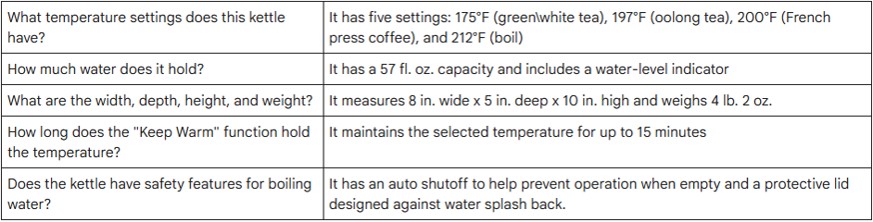
[question_and_answer]: Allows merchants to feed specific FAQs directly to the AI (examples below).
[document_link]: Direct links to user manuals, spec sheets, or warranty info.
- This may be one of the most interesting additions to the feed attributes in some time. PDF specs and documents for industries like electronics, vehicle parts, equipment, medical products, etc. are chock full of rich information.
- The more information we can “feed” to Google, the better!
[related_product]: Guides the AI to understand your catalog’s ecosystem for cross-selling.
Some examples of good uses here could be:
- A baby crib, mattress, sheet set, and sound machine
- A gaming console with controllers and accessories
- A printer with paper and ink cartridges
[item_group_title] & [variant_option]: Provides deeper context on product relationships, sizing, memory, and color variations.
[popularity_rank]: Helps the AI understand trending or top-tier products within your catalog.
- It’s not clear yet how Google will use and interpret this data specifically for AI-mode Shopping, but we expect it to help clarify what products are most popular within a specific category.
- If a shopper is conducting a search for “What’s the best in-home elliptical available in 2026?”, home-gym equipment retailers who use this attribute will make it easy for Google to determine which elliptical in the brand’s lineup to recommend.
Note: Google specifies that if you are already passing highly detailed information in your [description], [product_highlight], or [product_detail] attributes, you don’t need to duplicate it here. However, these new fields allow merchants to structure data exactly how a conversational AI wants to ingest it. We always recommend providing Google as much information as you have at your disposal.
The Impact on AI Mode & Beyond
The introduction of conversational attributes marks Google’s transition from keyword-based product matching to context-based product matching. That change is especially important as we see longer, more complicated searches written in a conversational way.
When a shopper uses Gemini or AI Mode to ask, “What are the best noise-canceling headphones for exercise that also have a headphone jack?”, the AI doesn’t just scan titles. It synthesizes data. If your feed utilizes the [question_and_answer] attribute to explicitly state the presence of a headphone jack, and the [variant_option] to highlight sweat-resistant colors, the AI is far more likely to confidently serve your product over a competitor who only relies on a standard description.
Ultimately, these attributes give you direct influence over how your brand is represented in AI-generated summaries, improving both traditional search experiences and next-gen AI discovery. As always, the primary goal is to make sure your products are showing up at the right time to the right users. Leveraging these attributes will directly influence if you appear in AI mode and Gemini…at least until the next big change in AI-assisted shopping.
Measuring Success: New AI Performance Insights
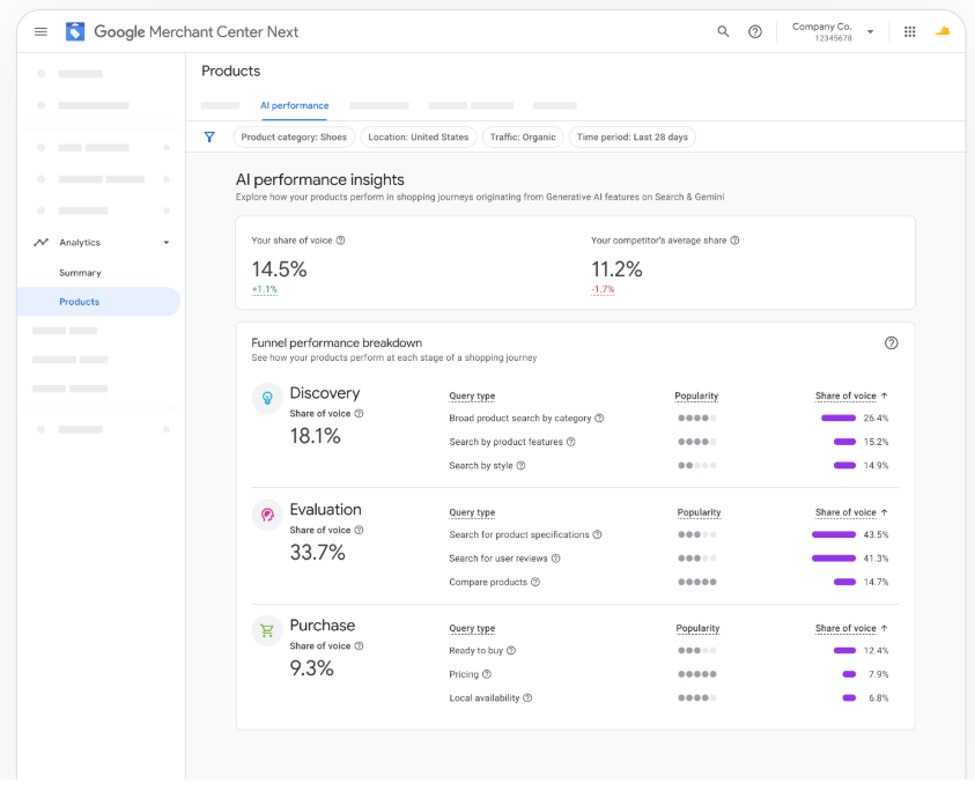
Understanding the direct impact of feed optimizations on product performance has always been difficult, and AI results are making it even more so. To bridge the reporting gap in this new era, Google is rolling out AI Performance Insights within Merchant Center. While we’ve not seen this appear publicly yet, we expect it to come in the second half of 2026.
This new reporting suite is designed to give merchants a clear view into how their products are performing specifically on AI surfaces. The standout feature here is Share of Voice (SOV). For the first time, advertisers will be able to see their brand’s visibility on AI-driven experiences benchmarked directly against similar brands.
This is a game-changer. It transitions AI shopping from a “black box” of ambiguity into a measurable channel where you can actively track the impact of your feed changes/updates.
Expert Recommendations: How to Take Action
To capitalize on these updates, merchants need to move quickly. Below are some immediate tactics and strategies you could implement to dominate AI-powered shopping.
Immediate Tactics (Next 30 Days)
1. Utilize the [popularity_rank] Attribute to Highlight Top Performers:
Do not attempt to overhaul your entire catalog on day one. You could simply identify a subsection of items to update, or even upload a supplemental feed (which Google recommends for this update) to append [question_and_answer] and [variant_option] data to your top 20% highest-margin or best-selling products.
2. Mine Your Customer Experience Information:
Your customer service team is sitting on a gold mine of conversational data, especially common questions, tactics used to close sales, and more. Take the most common pre-purchase questions from your live chat, phone calls, or product page FAQs, and map them directly into the [question_and_answer] attribute.
3. Establish Your AI Baseline:
As soon as the AI Performance Insights report populates in your Merchant Center, pull your initial Share of Voice metrics. Identify which product categories are lagging in AI Overviews compared to traditional Shopping ads.
Long Term Strategies
1. Shift from “Data Entry” to “Contextual Feed Management”:
Future-proof your feed by treating your product data as a knowledge graph. AI wants to know how products relate to one another ([related_product]) and why they matter to consumers ([popularity_rank]). Build automated systems to dynamically update these fields based on real-time inventory and sales velocity.
2. Unify SEO/GEO Strategies, User Experience, and Feed Strategies:
The data feeding your conversational attributes should not live in a silo. Your SEO/GEO content, customer service transcripts, and Merchant Center feeds must be aligned. A consistent brand voice across all these touchpoints ensures that whether a user is scanning your site or talking to Gemini, the product narrative remains consistent.
3. Iterative Optimization Based on SOV:
Use the new AI Performance Insights to ideate new A/B tests. If your Share of Voice drops in Gemini for a specific category, tweak your [question_and_answer] formatting to be more conversational or update your [document_link] to point to a more comprehensive buying guide.
The Bottom Line
The brands that win the next era of ecommerce won’t just have the best products – they will have the most complete, contextual, and AI-readable product data. By embracing Google’s conversational attributes (and eventually AI Insights), you are not just checking a box on a new feature; you are getting ahead of the curve in capitalizing on a vital competitive advantage in the AI-first future of retail.
Ready to Optimize?
Whether you’re short on bandwidth or unsure where to start, our Product Feeds team is here to help. Let’s turn your product data into a context-rich performance powerhouse.