

1. Google Announces December 2025 Core Algorithm Update
The December 2025 core update launched today! The tech giant said it should take about three weeks to roll out, and it is a regular update focused on surfacing “relevant, satisfying content for searchers from all types of sites.” The ROI Revolution SEO team will monitor our clients’ rankings and look for trends over the next several weeks. Please reach out to us if you have questions.
2. Google Releases Gemini for Home Voice Assistant, a Google Maps Boost, and Gemini 3
Google’s AI Assistant, Gemini, has been a busy bot since our last edition of this newsletter. Between the end of October and mid-November, Google rolled out the Gemini Home Assistant, a boost to Google Maps that makes Gemini act like your passenger-seat navigator, and a major update.
Gemini for Home Voice Assistant
In the United States, for owners of Google Nest and Google Home products made since 2016, Gemini for Home Voice Assistant is available to answer questions ranging from sports trivia to what time your child got home from school.
This product employs voice search to answer questions, and Google is encouraging users to use it for planning trips, shopping, finding recipes, and more, so we recommend ensuring your website is optimized for voice search. If you are unsure about that, just contact your ROI Revolution SEO team, and we’ll be happy to help!
Google Maps Navigation with Gemini
Have you ever wished you could ask your maps app to find a restaurant and add it as a stop during a road trip? You can now. Google recently added a feature to Maps Navigation that allows you to have a conversation about your route, including adding stops along the way. It can also show you major landmarks to ensure you don’t miss your turns as you travel.
The announcement explains, “Gemini does this by analyzing Google Maps’ fresh, comprehensive information about 250 million places and cross-referencing it with Street View image” to identify the most helpful landmarks on your route.
Gemini 3 Launches Everywhere on Day One
On November 18th, Google announced the roll out of Gemini 3 to AI Mode, the Gemini app, AI Studio, Vertex AI, and Google Antigravity – all on day one. This unprecedented move came with a note from CEO Sundar Pichai explaining that the update combines all of Gemini’s capabilities, allowing it to understand nuanced problems and better interpret the intent behind a user’s request. It can provide better answers and promises to skip the cliches and flattery.
3. New Data: Does llms.txt Actually Affect AI Citations?
A new analysis from SE Ranking, examining 300,000 domains found llm.txt file adoption to have no measurable link to AI citation frequency.
SE Ranking’s crawl found llms.txt on 1 out of every 10 domains in the most recent dataset. Their dataset showed that high-traffic sites were slightly less likely to implement llm.txt than mid-tier websites.
While implementing llms.txt is low effort, the data suggests site owners should not expect a lift in AI citations today.
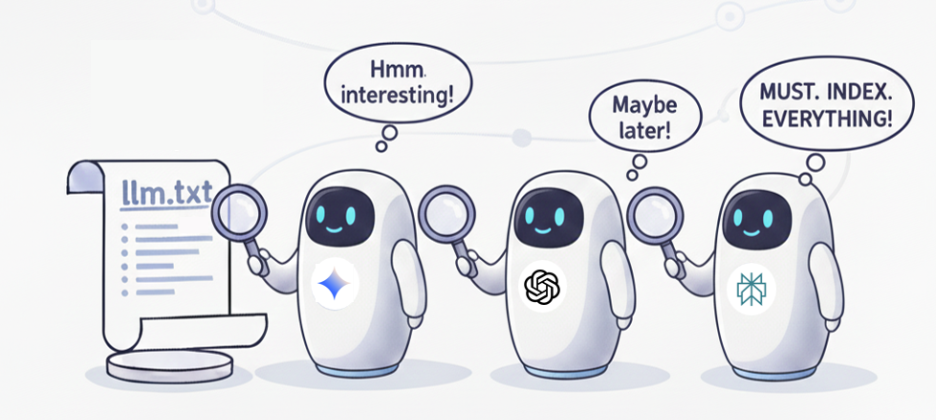
In August 2025, SEO/GEO expert Rachel Anderson tested implementing llms.txt. None of the known AI bot crawlers crawled the file until October 2025. After OpenAI crawled the file, she has seen zero impact from implementing this file. Unlike the long-established robots.txt protocol, which search engine bots generally follow to respect crawl and indexing instructions, llms.txt is an informal proposal. As of now, no major AI platform has officially confirmed that their large language model (LLM) crawlers actively use, read, or adhere to the llms.txt file.
4. AI Agents Want to Be Your Digital Shoppers & Travel Planners
Agentic AI is having its moment in the spotlight, going above and beyond the capabilities of answer engines to perform tasks for users. For digital marketers, the focus is quickly shifting from ranking high in traditional search results to being a trusted, accessible source that AI agents choose to cite and transact with.
The latest round of new AI features from Google, Microsoft, and ChatGPT are especially important for ecommerce and travel marketers. Here are the top takeaways:
Google’s Agentic Checkout is Live
Google has introduced agentic shopping features like Agentic Checkout for the holiday season. This allows an AI (using the user’s Google Pay details) to automatically track and purchase a product on an eligible merchant’s site when the price hits a user-defined target.
Implications for Marketers: Your product data, availability, and merchant trustworthiness must be optimized. If the AI cannot complete the transaction seamlessly on your site, you will lose the sale entirely.
AI Overviews Now Show Free Product Listings
Google is testing prominently displaying free product listings (from Google Merchant Center feeds) directly within the AI Overview at the top of the search results page.
Implications for Marketers: Your Google Merchant Center feed is becoming an increasingly important SEO asset. Ensuring accurate pricing, high-quality images, and robust product data is now critical for visibility in this prime AI-driven real estate. Need feeds help? Contact your ROI Revolution team to discuss our service.
The AI Can Call Your Store
Google is rolling out a “Let Google Call” feature (powered by Duplex technology) that allows the AI to call a local business on the user’s behalf to check for in-stock inventory and current promotions.
Implications for Marketers: Accuracy in your Google Business Profile and local inventory data feeds is essential. While this feature can drive foot traffic, merchants have the option to opt-out.
AI is Planning and Booking Travel
Google is expanding its AI Mode with features like Canvas for building custom trip itineraries and agentic booking for restaurant reservations, event tickets, and eventually flights and hotels.
Implications for Marketers: Users can now compare and plan complex trips entirely within the search interface. Content that establishes strong E-E-A-T (Experience, Expertise, Authoritativeness, and Trustworthiness) will be vital for the AI to choose your platform as a source for flight, hotel, and activity data.
Citations are the New Clicks
Microsoft’s Copilot is placing a strong emphasis on prominent, clickable citations back to the source publisher.
Implications for Marketers: This emphasizes a move toward optimizing pages to be a source. The goal is not just to rank, but to be the credible, trustworthy source that the LLM chooses to quote. Content with strong structure, clear authorship, and quality structured data (Schema) is more likely to be cited, leading to highly qualified, high-intent traffic.
5. Search Console’s AI Upgrade: Topic Clusters & Social Insights
The SEO toolkit is getting a major upgrade. Google Search Console (GSC) is evolving from a raw data repository into a strategic intelligence platform powered by AI. These updates make it more intuitive and align data analysis with a content-first, topic-cluster approach.
Here are the GSC updates that are already live or in an experimental rollout:
Query Groups in Search Console Insights:
GSC is moving beyond individual keywords. A new, AI-driven feature called Query Groups automatically clusters similar search queries based on shared user intent.
Implications for Marketers: You can now analyze your performance for an entire topic cluster or user need, rather than getting lost in thousands of long-tail keyword variations. This allows content marketers to more clearly identify content gaps and topics that are trending up or down with a single view.
AI-Powered Configuration (Experimental)
Google is testing an LLM-driven configuration tool in the Performance report. Users can now use natural language to build complex reports (ex. “Show me mobile clicks vs. desktop CTR for blog pages in the US this quarter compared to last quarter”) instead of manually setting filters and comparisons.
Implications for Marketers: This lowers the barrier to complex data analysis. While currently experimental, the long-term trend is clear: analytics will become more accessible, allowing digital marketing teams to get answers faster.
Custom Annotations
You can now add your own contextual notes directly onto the Performance charts in GSC. This allows you to mark key events like major site updates, content pushes, technical fixes (like an indexing bug), or external business events (ex. a new campaign launch).
Implications for Marketers: This creates a new source of truth for all users of a property, directly linking actions to performance movements. The annotations are visible to everyone with property access.
Social Channels in Search Console Insights (Experimental)
Google is experimenting with integrating social media performance data into the GSC Insights report. It automatically detects and links associated social profiles like YouTube, TikTok, and Instagram to report on:
- Total clicks and impressions from Google Search to your social profiles
- Top-performing social posts and trending content
- Search queries that lead users to your social profiles
Implications for Marketers: This is Google’s acknowledgment that a brand’s presence in Search is no longer just their website. It provides a unified view, allowing marketers to better understand how their social content contributes to their overall search visibility and brand discovery. It reinforces the need for consistent brand profiles and high-quality content across all channels.
6. Schema Is Still Important to Google and LLMs
Google has dropped support for more structured data types (also referred to as schema markup). A recent announcement by Search Advocate John Mueller, stated that the team is “constantly working to simply the search results page,” which means removing features that aren’t being used often.
In follow up conversations, Mueller specified that the “Today’s Doodle” box, nutrition facts, nearby offers and events, and TV season selector are among the features being removed, which means, for Google, the structured data that feeds those features is not necessary.
Google also clarified its review snippet documentation, to prevent ambiguity and ensure it can better understand reviews and aggregate rating structured data. The information is worth reviewing if you want accurate ratings and reviews to be shown alongside your products and services in the SERPs.
While these changes are issued by Google, it’s important to keep in mind that LLMs, like ChatGPT, Gemini, and Perplexity, are using structured data to understand your pages. So, even if Google isn’t supporting a specific markup, it might still be worth including, depending on your goals.
7. Cloudflare Outages Cause Error Spikes and Headaches
In mid-November, Cloudflare, a popular internet infrastructure company used by websites and services around the world, went down for several hours. The outage caused a spike in 5xx errors for websites and apps that sit behind its network. While these errors are problematic for site users, they normally do not cause long-term SEO issues.
When they encounter those errors, Google’s crawlers temporarily slow down, but as long as the issue is resolved quickly, pages do not run the risk of being dropped from the index.
Just a few weeks later, Cloudflare suffered another, brief outage that caused it to be down for several minutes. The company says it was not caused by an outside attack and that it is investigating.
ICYMI: Recent SEO Blog Posts
Making the Most of the Shopify/ChatGPT Integration
SEO & Paid Media Collaboration: Boosting Google Ads Quality Scores Together