

1. Grouped Ad Labels for Search Ads Are Live
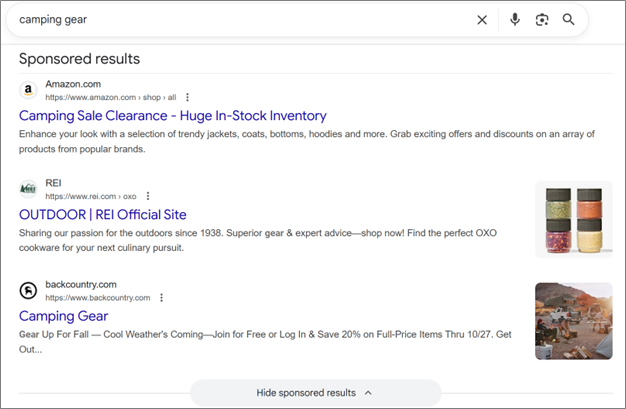
A recent change rolled out by Google may make it more difficult for users to identify sponsored results versus organic listings. Ads were previously labeled as “sponsored” individually; they will be grouped under a single “Sponsored results” label in the SERPs moving forward.
This search ads update began testing in May of this year and was officially rolled out on October 13th. Google wrote that this is intended to “make navigation easier” for users, but since sponsored ads now blend into the SERPs and look much closer to organic snippets, website owners may notice a change in click behavior and traffic sources. Here’s an example of the new grouped ad labels:
2. Price Tracking Graph Added for Each Retailer
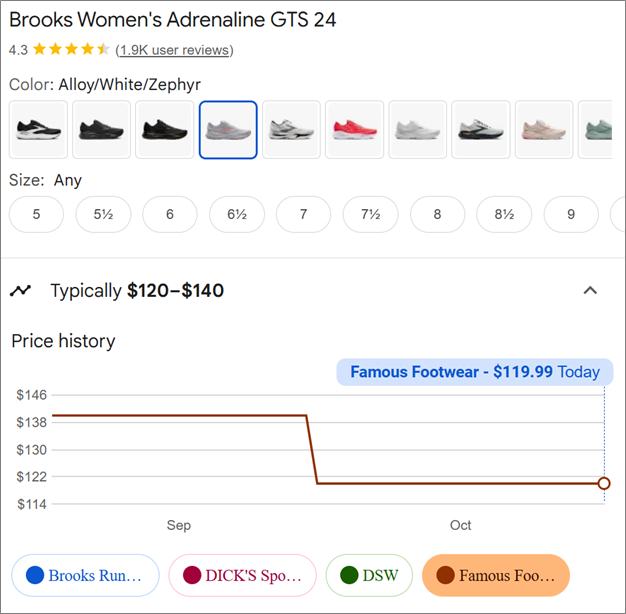
Users will now be able to view pricing over time for each retailer within Google Search. Google has added price tracking charts, which enable users to compare pricing changes for products available from multiple retailers.
Although this change doesn’t appear for every search, you can look for it by clicking a product tile from Google Search and expanding the “Typical” price range area in the product panel that opens on the right side of the screen. Below is an example:
3. OpenAI Launches “Buy It in ChatGPT” and a New Web Browser
In the last month, OpenAI has made two huge announcements:
- Buy It in ChatGPT is live but limited to Etsy, with Shopify sellers coming soon. The feature is available to all users, and at launch, was only available for single-item purchases. Called Instant Checkout, the feature allows users who are conversing with the chatbot to make a purchase within the chat. The seller must use Stripe as their payment processor with the right bit of code on their site, or they can “accept agentic payments either by using Stripe’s new Shared Payment Token API or adopting the Delegated Payments Spec in the Agentic Commerce Protocol—all without changing their existing payment processor.”
In the announcement, OpenAI said participation in Instant Checkout will not influence ChatGPT’s recommendations when a user asks for the best gifts for fans of porcelain or a good pair of running shoes. However, it also lists this streamlined user experience as one of many considerations when making recommendations. - On October 21st, OpenAI took to YouTube to announce the release of ChatGPT Atlas, the tech company’s new AI-powered web browser, built upon ChatGPT. The browser will reportedly be able to perform agentic tasks, like searching for concert tickets, creating shopping lists based on an online recipe, and even starting an Instacart order. It should stop at the point of checkout to let the user review the order before making the purchase.
One off-handed comment made during the video seems worth calling out – if you’re not intentionally using the agentic feature, it’s best to be logged out of your ChatGPT profile because it will track everything you do while you’re logged in.
The browser appears to be using Google as its search engine, at least in the walk-through on YouTube. Why is that notable? Because it means that good SEO practices are still as important as ever to ensure your business has its best chance of being seen by the right users.
4. Google’s Liz Reid and Robby Stein Say Search Is Not Dead
In recent interviews, Liz Reid, head of Google Search, and Robby Stein, VP of product at Google, have reiterated that Search is not dying, but it is changing.
In her interview with The Economic Times, Reid said that Search is having an “expansionary moment,” meaning that as AI Overviews and AI Mode are shown more in results, people are asking longer questions and adding constraints within the query. The wider variety of queries leads to more AI Overviews and AI Mode usage. At the same time, the traditional results are not going away.
Reid was also interviewed by The Wall Street Journal on the Bold Names podcast, and in that interview, she was asked about how AI Overviews and AI Mode were affecting ad revenue. She answered that while ad clicks were down, more queries meant more ads were being shown, so ad revenue is stable.
Lenny Rachitsky interviewed Stein on Lenny’s Podcast, and Stein shared a similar message: Search is having an expansionary moment, adding that the usage of Google Lens for visual search has grown 70% year-over-year. He explained how the query fan-out process works, and explained that publishers and creators should be thinking about the best way to serve users who land on their site.
“And so, if I were a creator,” Stein explained, “I would be thinking, what kind of content is someone using AI for? And then how could my content be the best for that given set of needs? I think that’s a really tangible way of thinking about it.”
The nugget of wisdom in all three interviews? Make your website’s content as helpful and as unique as possible. If it says the same thing that’s been repeated across the web “500 times,” then Google isn’t likely to select it. In other words, highlight your company’s experience, expertise, and authoritativeness, the “E-E-A” in E-E-A-T.
ROI Answers: What’s the difference between topical authority and brand authority?
Topical authority is demonstrated expertise and credibility for a subject. It’s an expression of your company’s experience, expertise, authoritativeness, and trustworthiness (E-E-A-T), and it’s created by building comprehensive, helpful content around topics that are relevant to your business. For example, a car company that wants to be known for their new electric vehicles will create in-depth, unique content on how they work, benefits, maintenance, accessories, and long-term value.
Brand authority is topical authority plus the company’s reputation, including the respect others give the business online. When you think of electric vehicles, which brands immediately come to mind? Which brands are recommended, written about, and celebrated over and over? Those brands have built brand authority.
To learn more about building topical authority, read our blog post, How to Build Topical Authority for SEO. Or contact us to discover how you can improve your website’s E-E-A-T, topical, and brand authority.