

In the world of Google Ads, Quality Scores can make or break your campaign performance. They affect where your ads show, how much you pay per click, and ultimately how efficiently you can scale your budget. But too often, improving Quality Scores is seen as a Paid Media-only problem. In reality, the strongest results come from collaboration, especially between paid search and SEO teams.
At ROI Revolution, we act cross-functionally to move the needle. By identifying ads with low Quality Scores and optimizing the landing pages with support from our SEO team, we’re improving not just paid ad performance but organic visibility, too. We believe this integrated approach is key to smarter, more scalable marketing.
What Is a Google Ads Quality Score?
According to Google Ads documentation, Google Ads Quality Score is a diagnostic tool designed to help advertisers understand how their ad quality stacks up against competitors. Scores range from 1 to 10, with 10 being the highest. The closer your score is to 10, the more relevant and useful Google believes your ad and landing page are for someone searching that keyword.
There are three primary components to a Quality Score:
- Expected click-through rate (CTR): How likely it is that your ad will be clicked when shown.
- Ad relevance: How closely your ad matches the user’s search intent.
- Landing page experience: How relevant, useful, and user-friendly your landing page is.
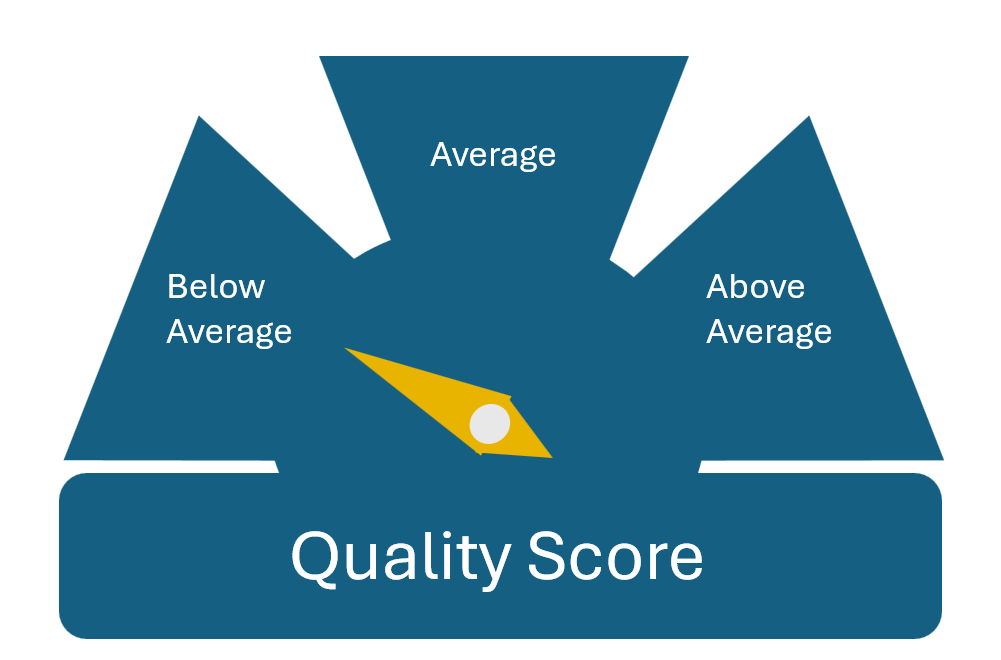
Each component is rated as Above Average, Average, or Below Average based on performance compared to other advertisers bidding on the same keyword over the past 90 days.
While Quality Score is a helpful benchmark, it doesn’t account for every real-time signal. Factors like device type, location, and time of day still influence ad performance, even when your Quality Score is high.
Why Do Landing Pages Matter?
Landing pages play a critical role in both the performance of your Google Ads and the experience your users have once they click. Google’s Quality Score takes landing page experience into account, evaluating factors like page load speed, content relevance, and ease of navigation.
A high-performing landing page should quickly deliver the information users expect based on your ad. That means matching the language, intent, and keywords used in the ad itself. For example, if your ad promotes blue shoes, sending users to a page about red shoes creates a disconnect that not only frustrates users but also signals a poor experience to Google.
These mismatches can contribute to “Below Average” Quality Scores, leading to higher CPCs and lower ad placements. A relevant, well-optimized landing page keeps users engaged and boosts both paid and organic performance.
Paid Media + SEO Working Together
When we notice that ads are underperforming due to low Quality Scores and weak or mismatched landing pages, we see opportunities to bridge efforts between our paid search and SEO teams to improve outcomes across both channels.
The paid media team begins by identifying keywords with Below Average Quality Scores in Google Ads. These keywords are then reviewed by the SEO team, who assess whether the current landing page aligns with the user’s intent. The SEO team then makes targeted content optimizations, adding or refining copy to better reflect those keywords, and, in some cases, recommending a more relevant landing page altogether.
These combined efforts lead to measurable improvements to the ads’ Quality Scores and corresponding paid search performance KPIs like CPC, CTR, and campaign ROAS.
How Quality Score Improvements Support Organic Performance
Efforts to improve Quality Score don’t just benefit your paid search campaigns, they often lead to stronger organic performance as well. Many of the same elements that boost relevance and landing page experience also align with SEO best practices. Here’s how:
- More relevant content helps improve keyword targeting and organic rankings.
- Enhanced user experience (UX) can reduce bounce rates and increase engagement, signals that benefit both Paid and Organic.
- Clearer page structure makes it easier for both users and search engines to understand and navigate your content.
- Cross-channel insights enable more consistent messaging throughout the funnel, improving overall marketing effectiveness.
When PPC and SEO teams align on shared goals, like landing page optimization, the results extend beyond ad metrics, leading to a more cohesive and effective digital strategy.
Breaking Down Silos for Better Results
The best performance doesn’t come from paid search or SEO working in isolation – it comes from collaboration. When teams share insights, align on landing page strategy, and optimize together, both channels benefit. Landing Page Quality Score collaboration is just one example of how breaking down silos can lead to more effective campaigns and stronger user experiences.
We encourage marketers to test, adapt, and stay curious. Quality Score improvements aren’t a one-time fix, they’re the result of continuous optimization and cross-functional teamwork. If you’re ready to maximize your digital marketing performance, contact our experts to learn how our unified multi-channel teams can help drive success towards your business goals today.