



In this edition: Spam update, new GSC reporting filter, and trouble for tracking tools
Google Rolls Out September 2026 Spam Update Globally
Highlights
- Released September 24th, 2026, Google’s Sept 2026 Spam Update is rolling out globally across all languages
- Google estimates the rollout will take up to two weeks to complete. This is notably longer than the multi-day timelines of earlier 2026 updates.
- Google hasn’t provided additional details about what this update targets.
- SEO tools and search analytics show significant SERP volatility underway as ranking positions adjust across industries.
SpamBrain is Google’s AI-based spam prevention system. Occasionally, Google improves that system to make it better at spotting spam.
Why it matters for ecommerce:
Risk Around Automated & Thin Content: Online stores that rely heavily on auto-generated product descriptions, duplicate supplier data, or thin programmatic tag pages are vulnerable during SpamBrain filter adjustments.
Direct Traffic & Revenue Impact: Ranking fluctuations on high-intent e-commerce keywords (category hubs, top-converting product pages) directly impact daily traffic from Google, conversion rates, and revenue.
New Google URL Altering Feature – “goto” URL Parameters
Google Search unveiled a new feature that alters the appearance of URLs users see on the SERP. URLs now follow a ‘goto’ URL pattern (https://www.google.com/goto?url=) when viewed in search results. This is a feature that Google began testing in July 2026 and rolled out late August.

Google is constantly running tests on search results, this being no different. In mid-2024, organic results in the SERP had an ‘srsltid’ query parameter attached to results. The ‘goto’ parameter is likely an evolution of the ‘srsltid’ parameter. This change may also be related to Google’s ongoing litigation against SerpAPI and other efforts to prevent third-party tools from scraping SERP results at a high velocity.
In a statement to Search Engine Roundtable, a Google spokesperson said,
“We have a long history of deploying technical measures against evolving forms of abuse, and we regularly take steps to protect our services and users.”
Search Engine Roundtable
Programmatic SEO Can Cause Google to ‘Lose Faith’ in Your Site
In a recent exchange on Bluesky, Google Search Advocate John Mueller cautioned against programmatic SEO, saying that it “often leads to a site that’s either spam, borderline spam, or low quality.”
Programmatic SEO can take many shapes but often involves the mass generation of URLs to target every keyword or concept that is theoretically relevant to your business. However, as Mueller explains, programmatic SEO often leads to low-quality, non-helpful content. This stands in contrast with Google’s guidelines for useful content and can lead to de-indexation of pages.
Deploying Programmatic SEO is easier than ever, and an increasingly common component of AI-powered landing page generation tools. Before starting to generate new pages at scale, contact the ROI Revolution SEO team to protect your current organic strategy.
Google Search Console Adds ‘Multimodal’ Performance Filter
Google is rolling out a dedicated Multimodal search filter in Google Search Console (GSC) performance reports. Under the Search Type filter options, web traffic is now categorized into Text-based and Multimodal.
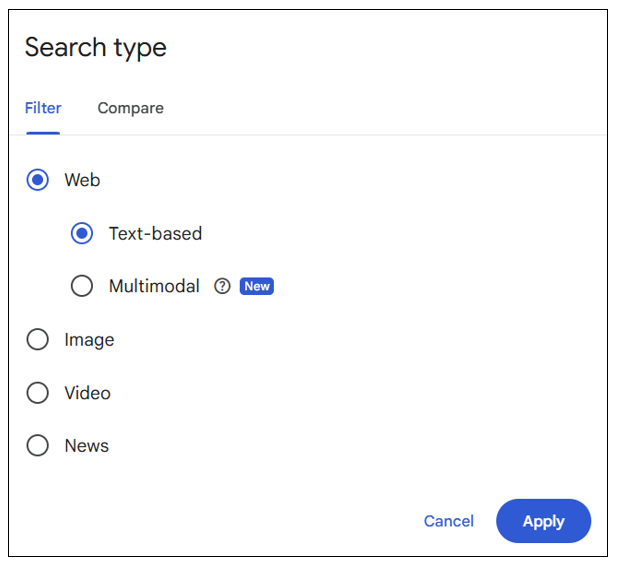
Source: screenshot from roirevolution.com GSC
Key Details:
- Visual Search Tracking: The new filter isolates web results triggered by visual inputs, including Google Lens, Circle to Search on Android, image uploads, and Chrome’s “Search this image” feature.
- No Text Query Data: Because visual searches rely on images rather than text inputs, Google confirmed that the Queries dimension is unavailable when the multimodal filter is applied.
- Data Shift: Multimodal traffic was previously bundled into standard web results. Site owners may notice slight drops in standard text-based web metrics as visual performance is split into its own category.
Why It Matters:
Visual search behavior is growing rapidly across mobile and desktop. This update gives SEOs clear visibility into how visual discovery features contribute to overall organic traffic.
People Also Asked Is Nearly Always Answered by AI Mode
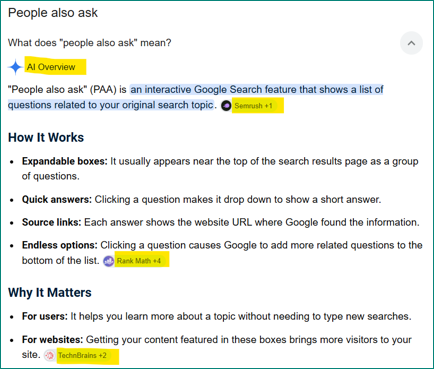
When Google announced earlier this year “Google search is now AI search,” they weren’t kidding. As of this month, the People Also Ask (PAA) feature is being answered by AI Mode 97% of the time. Of a sample of 19.2 million English language PAA answers studied by the team at alsoasked.com, 97% were answered by AI Mode, which is up from a reported 86% in August.
What does this mean for website owners? Like search results in the days of ten blue links, we used to be able to rely on knowing that, if we ranked for a People Also Ask answer, ours was the only website shown and had a decent chance of leading to website traffic. Now, we may be sharing the answer with several other cited websites, which can mean even fewer clicks through to the page that provides the answer.
In the example shown in this screen shot, there are 10 links a user might choose to click through to, if they choose to click at all. Ironically, the last bullet point in this AI-Mode answered PAA about PAA is not necessarily true.
Expect Image Thumbnails in Google SERPs to Take Time to Update
In an exchange on Bluesky, John Mueller explained that image thumbnails will often take more time to update in the SERPs than content, especially if the original image is still on the page.
User “Inspired Taste” asked him why their new thumbnail was not showing up on the results page two weeks after they made the change. John replied, “… in general, this can happen. The image is still very prominent on the page & continues to exist on the site, so it’s not unexpected to continue to be picked as a thumbnail.”
Later, Inspired Taste removed the original image from the page, and after a few more days, the thumbnail was updated in search results. Key takeaway? If you don’t want an image shown as a thumbnail after you’ve made an intentional change away from it, remove it from the page altogether.
Google Is Currently Winning at Anti-Scraper Whack-a-Mole
Google has long had rules against scraping its data for things like keyword ranking trackers. And yet, there is an entire business model build upon the process, and as SEOs we use those tools – Advanced Web Rankings, Ahrefs, and Semrush, for example. In recent months, Google has been more aggressively moving to defeat those tools and seems to be winning for the moment.
A recent article by Barry Schwartz at SE Roundtable and a conversation we’ve had with a representative from Advanced Web Rankings highlight the issue. Google’s current efforts include the “goto” URLs covered above and serving different results to bot traffic vs. human traffic. Of course, each of the different tools is working in its own way to try to get around Google’s latest obstacles, so while we wait, we should consider the ranking data from those tools carefully, knowing their current limitations.
We’ll be diving deeper on this topic in a future blog post, so keep an eye on the ROI Blog.